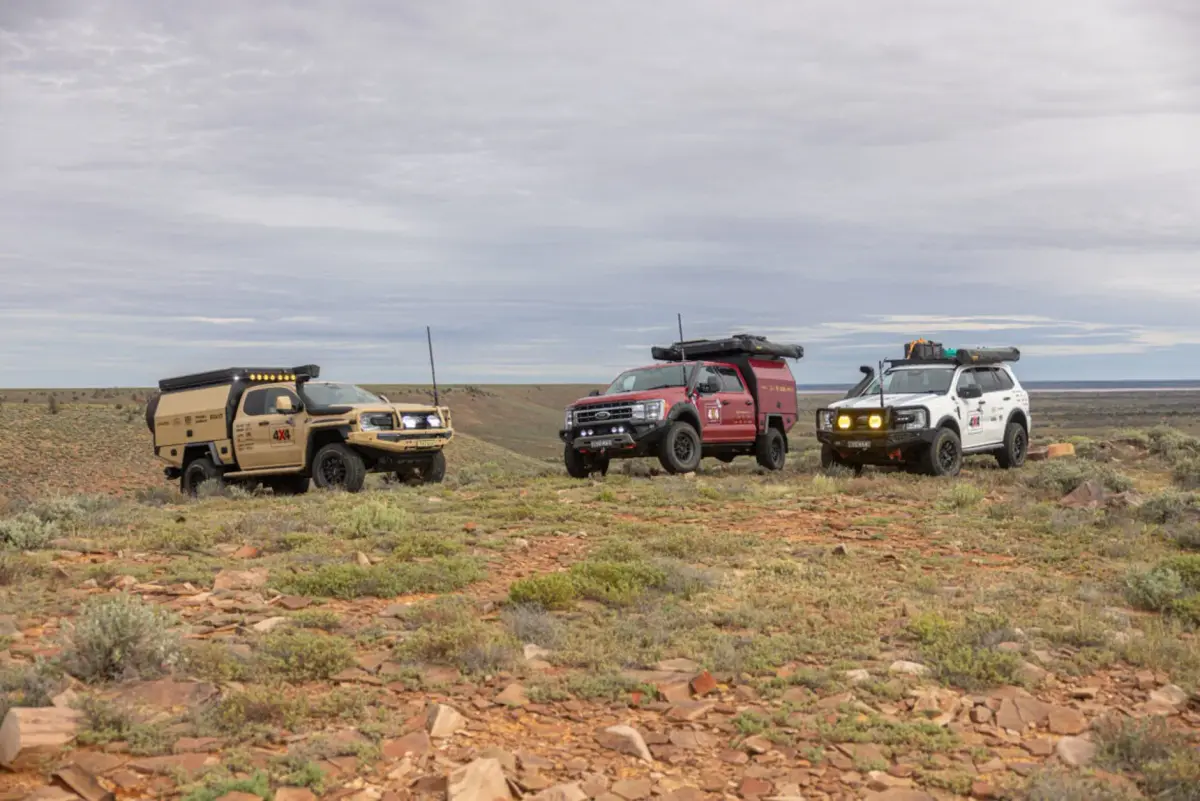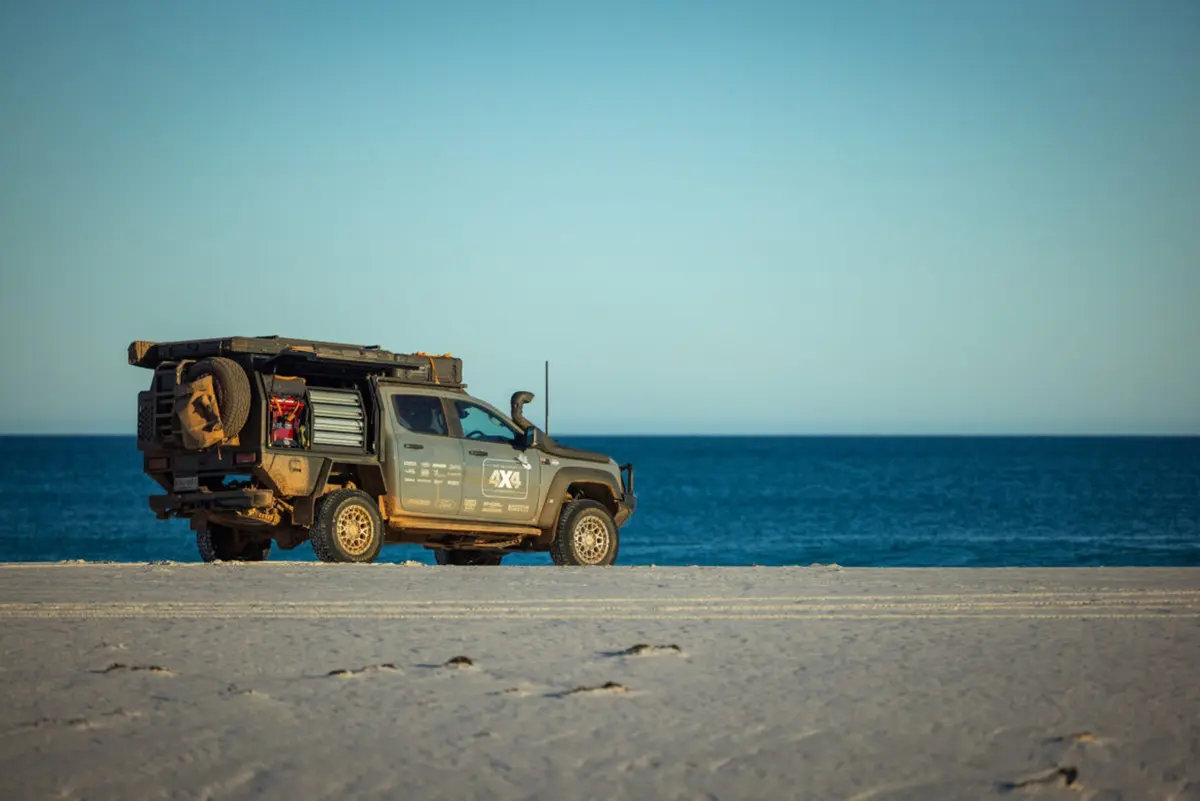

A dual battery system is a second battery in your 4X4, wired so it can run your fridge, lights, inverter and other gear without touching the battery that starts the engine. Done well, it means you wake up at a remote campsite, the fridge has run all night, and the vehicle still fires first go. Done badly, it means a flat starter battery, a cooked auxiliary battery, or a cable that gets hot enough to worry an insurer.
This guide covers what most retailers skip. We explain whether you need a dual battery system at all, why a DC-DC charger has replaced the old isolator on most modern vehicles, how to choose between AGM and lithium, how to size the battery to your fridge and your trip, where to mount it, what it really costs, and what goes wrong. We're not selling you a kit, so we can be straight about it.
The adventure starts where the bitumen ends
See how Club 4X4 can help
Do you Actually Need a Dual Battery System?
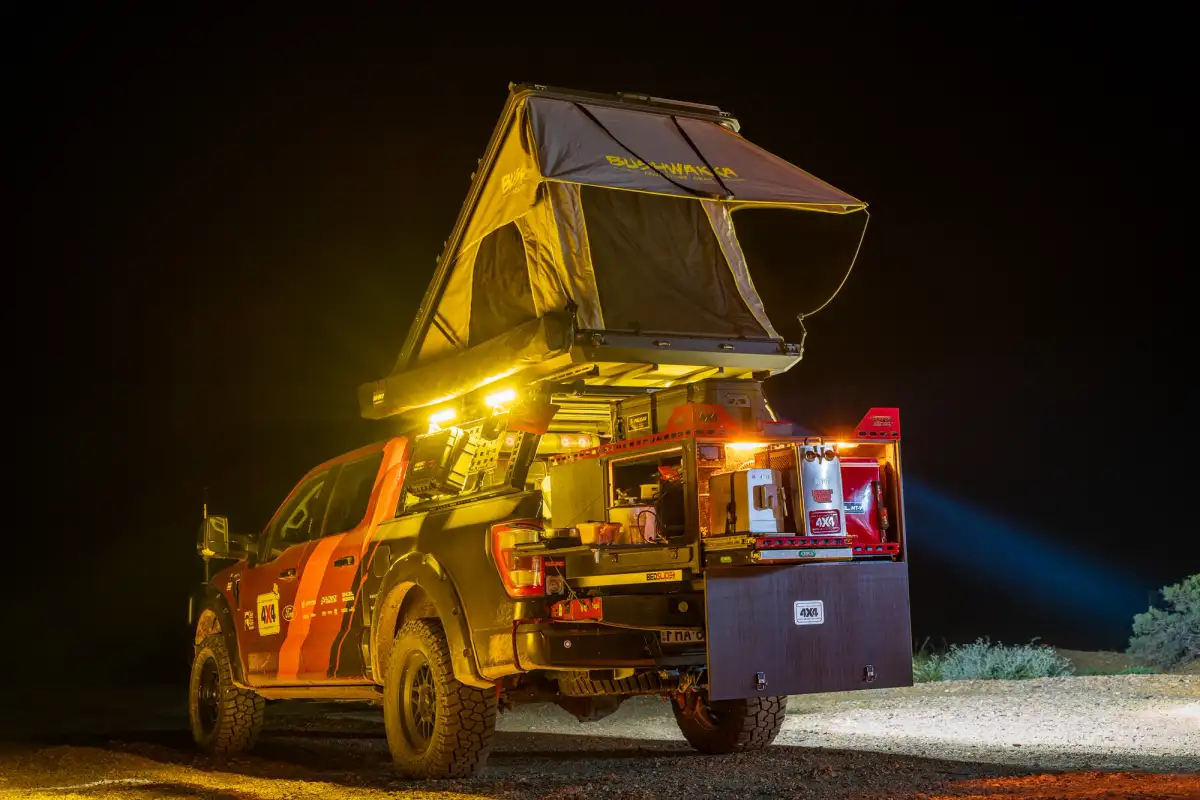
Pat Callinan's Ford F-150 4X4 ute with a modified canopy and battery system
Not always. If you do weekend trips, run a small fridge and have a portable power pack, you probably don't need one. A decent portable lithium unit can run a fridge for a couple of days, recharges at home, and never touches your vehicle's electrical system. For many campers that's the cheaper and simpler answer.
A second battery starts making sense when one or more of these is true:
- You run a compressor fridge every trip and stay more than two nights in one spot.
- You camp where there's no mains power and want the fridge, lights and phone charging to work, without carrying and charging separate packs.
- You run extras such as an inverter, air compressor, UHF, driving lights, a winch or camp lighting off the vehicle.
- You tow a camper trailer or caravan and want the vehicle to charge the trailer battery on the road.
- You work from the vehicle and need reliable power for tools or equipment.
The deciding question is simple. Would a flat starter battery leave you stranded somewhere that matters? If the answer's yes, keep the cranking battery isolated from everything else. That's the whole job of a dual battery system.
VSR Versus DC-DC: the Difference that Matters
Every dual battery system needs a way to charge the second battery from the alternator while you drive, and to disconnect it when the engine's off. There are two ways to do that, and choosing the wrong one is the most common mistake we hear about.
Isolators and Voltage Sensitive Relays (VSR)
A dual battery isolator, including a voltage sensitive relay, is a simple switch. When the starter battery voltage rises above a set point, as it does when the engine's running, the relay closes and joins the two batteries. When the voltage drops, it opens and separates them. It's generally cheap, simple and robust.
The problem is that it only joins the batteries. It cannot change the voltage or current going into the auxiliary battery.
DC-DC Chargers
A DC-DC charger sits between the two batteries and actively manages the charge. It takes whatever the alternator delivers, boosts or regulates it, and feeds the auxiliary battery with a proper multi-stage charge profile for that battery type. Most also accept solar input and many include a monitoring function.
Why it Matters on Modern Vehicles

two people sat around a campfire in Outback Australia next to their Toyota LandCruiser 4X4
Most newer 4X4s have smart or variable-voltage alternators. These drop the output voltage when the vehicle's own battery is full, to save fuel and cut emissions. A VSR sees that lower voltage and opens, so the auxiliary battery gets little or no charge. Even when it does connect, the voltage is often too low to fully charge it, and the current is unregulated.
A DC-DC charger solves both problems. It keeps charging from a smart alternator, it protects your starter battery, and it charges lithium batteries correctly, which a plain relay cannot do. For most modern vehicles, and for any lithium auxiliary battery, a DC-DC charger is the better choice. A VSR can still work on an older vehicle with a conventional alternator and an AGM battery, where its simplicity is a real advantage.
| Feature | VSR or Isolator | DC-DC Charger |
|---|---|---|
| Works with smart alternators | Often poorly or not at all | Yes |
| Charges lithium correctly | No | Yes, with the right profile |
| Regulates charge current | No | Yes |
| Solar input | No | Often built in |
| Cost | Lowest | Higher |
| Best for | Older vehicles with AGM | Most modern vehicles, and all lithium |
AGM or Lithium for the Auxiliary Battery
Both chemistries work. The right one depends on your budget, your space and how hard you use the system. We could go into extreme detail, but here's the short version.
- Weight: a lithium (LiFePO4) battery weighs roughly half as much as an AGM of the same rated capacity, which matters in a tub, canopy or behind the seat.
- Usable capacity: lithium delivers close to its full rated amp hours. An AGM should not be discharged much past 50 per cent if you want it to last, so a 100Ah AGM gives you about 50Ah you can really use.
- Cost per usable amp hour: lithium costs more up front, but once you count usable capacity and cycle life the gap narrows considerably. For regular, heavy use it is often cheaper over the life of the battery.
- Charge acceptance: lithium accepts a high charge current, so it refills faster during a day of driving. AGM tapers off as it fills.
- Cold weather: AGM tolerates charging in the cold better. Most lithium batteries should not be charged below about 0 degrees Celsius unless they have built-in heating or low-temperature protection. Check the specification if you camp in the high country.
Our rule of thumb: choose AGM if you want the lowest entry cost and you have the room and weight to spare. Choose lithium if you use the system hard, want to save weight or need a slimline format. If you go lithium, you need a DC-DC charger with a lithium charge profile. See also our overview of lithium batteries: what you need to know.
Sizing it to your Fridge and your Trip
The most common sizing mistake is buying a battery by price or by what a mate has. Size it from your loads instead. The method takes five minutes.
Step 1: Work out your Daily Consumption
Add up the amp hours each device draws in a 24 hour period. A compressor fridge doesn't run continuously, so use its average draw rather than its peak. Your best bet is to check the manufacturer's figures.
Step 2: Multiply by your Days Off-Grid
Multiply your daily total by the number of days you want to run without driving or solar.
Step 3: Allow for Depth of Discharge
Divide by the usable portion of the battery: roughly 0.5 for AGM and 0.8 to 0.9 for lithium. Then add a margin of 20 per cent for cold weather, ageing and unplanned extra loads.
Worked Example
Say you run a 50 litre fridge averaging 2 amps over 24 hours (48Ah a day), LED lighting and device charging adding 10Ah a day, and you want two days with no solar and no driving. These figures are illustrative; use your own.
| Step | Calculation | Result |
|---|---|---|
| Daily use | 48Ah fridge + 10Ah other | 58Ah a day |
| Two days off-grid | 58Ah x 2 | 116Ah |
| Lithium (85% usable) | 116 / 0.85, plus 20% margin | About 164Ah, so a 200Ah battery |
| AGM (50% usable) | 116 / 0.5, plus 20% margin | About 278Ah, so roughly 300Ah of AGM |
That comparison is why lithium makes sense for longer trips: the AGM needs far more rated capacity, and far more weight, to deliver the same usable energy.
How Long will a Dual Battery Last?
There are two answers. Per charge, it lasts as long as your usable capacity divided by your daily use. In the example above, a 200Ah lithium battery with about 170Ah usable runs the setup for roughly three days. Over its life, a lithium battery is typically rated for thousands of cycles, while an AGM used heavily and discharged deeply may need replacing in a few years. Both last longer if you avoid deep discharge and charge them with the right profile.
Solar Changes the Maths
A solar input takes the pressure off. A 200 watt panel in good sun can return somewhere around 60 to 80Ah in a day, which can cover a fridge's entire daily draw. Output varies with season, shade and panel angle, so treat it as a top-up, not a guarantee.
Under Bonnet, Rear Tub or Portable
Where the battery lives affects heat, weight distribution, cable length and cost.
- Under bonnet: keeps cable runs short and the load cabin free, but engine bay heat shortens battery life, space is tight on many vehicles, and lithium batteries are often not suited to it. Check the manufacturer's temperature rating.
- Rear tub, canopy or tray: a cooler location with room for a larger battery and a distribution panel. The trade-off is a long cable run from the front of the vehicle, which means heavier cable and more cost.
- Behind the seat or in the cabin: a good fit for slimline lithium batteries in dual cabs. Shorter runs than the tray, protected from weather.
- Portable battery box: a battery, a plug and a few outlets in a box. It is the cheapest way in and is easy to move between vehicles, but it needs separate charging, so it is not a full dual battery system.
Whatever you choose, mount the battery securely. A loose battery in a rollover or hard braking is a hazard.
What it Costs
This is the question most people arrive with, and most retailers answer it vaguely. The honest answer is that it depends on the battery, the charger and who fits it. These ranges are drawn from published retail pricing in Australia at the time of writing (November 2026). Prices change, so check current listings before you budget.
| Approach | What you get | Indicative price (AUD) |
|---|---|---|
| DIY components | DC-DC charger, battery, cable, fuses, monitor bought separately | Charger alone from about $550 to $700 (for example, a 40A to 50A unit); lithium batteries from about $1,800 for 150Ah to about $2,500 for 200Ah |
| Prebuilt kit | Charger, monitor and wiring, battery often extra; some kits include a lithium battery | Charger and monitor kits from roughly $800 to $1,000; complete lithium kits from about $1,050 (100Ah) to over $3,000 (200Ah+ with inverter) |
| Pre-wired power panel | Integrated charger, fusing and monitoring for canopies | Roughly $2,000 to $3,700 for the panel, battery extra |
| Professional install | Components plus labour, fitting, testing and handover | Parts as above plus labour. Installers quote about 8 to 16 hours for typical jobs, longer for complex canopy builds. Get written quotes |
Sources: REDARC, iTechworld, Battery Zone and 4X4 OFFROAD published pricing and install information, viewed November 2026.
So, how much does it cost to install a dual battery system? For a typical lithium setup with a DC-DC charger, expect a few thousand dollars all up once you include the battery, wiring, fusing and a professional install. A basic AGM and DC-DC combination fitted into a simple location will sit toward the lower end. A canopy build with solar, an inverter and a distribution panel will sit well above it.
Where the Money Goes
- Battery: usually the largest single item.
- DC-DC charger: a 25A unit is fine for a small battery; 40A to 50A suits larger lithium batteries and recovers faster.
- Cable and fusing: do not economise here. Thicker cable costs more, and it is what stops voltage drop and fire risk.
- Labour: a neat install takes a day or more. A rushed or cheap one costs you later.
Kit or Components?
A prebuilt dual battery kit saves research and guarantees the parts are matched. Buying components lets you choose a better battery or a larger charger and avoid paying for items you don't need. If you're not comfortable with high-current wiring, buy the kit or have it fitted. Either way, make sure the charger profile matches the battery chemistry.
The Best Dual Battery System in Australia
There is no single best system. The best one is matched to your vehicle, your battery chemistry and your trips. What we can say is what to look for:
- A DC-DC charger from a manufacturer with local support and a clear warranty process.
- A battery whose maker states the charge and discharge limits, and ideally has built-in protection.
- Compatibility with your vehicle's alternator, and a proper installation location.
- Room to grow: spare capacity in the charger, a panel that can take solar and an inverter later.
Brands such as REDARC, iTechworld and KickAss all sell complete kits at a range of prices, and each suits different budgets and mounting locations. Compare the specification sheets rather than the marketing, and match the charger to the battery you plan to run.
Wiring, Fusing and Cable Runs
Wiring is where a good system is made or ruined. The principles are simple:
- Fuse every positive cable as close to the battery as practical. A fuse protects the cable, not the equipment.
- Size the cable for the current and the length of the run. Undersized cable causes voltage drop, wastes charge, and overheats.
- Use correctly rated lugs, crimped with the right tool, and heat shrink to seal them.
- Run cable away from sharp edges, exhaust parts and moving components, in protective conduit, with grommets where it passes through metal.
- Use a quality earth connection to a clean, bare metal point or a dedicated negative bus.
A typical layout runs from the starter battery through a fuse to the DC-DC charger, then through another fuse to the auxiliary battery, with a distribution panel or fuse block for accessories and a shunt or monitor on the negative.
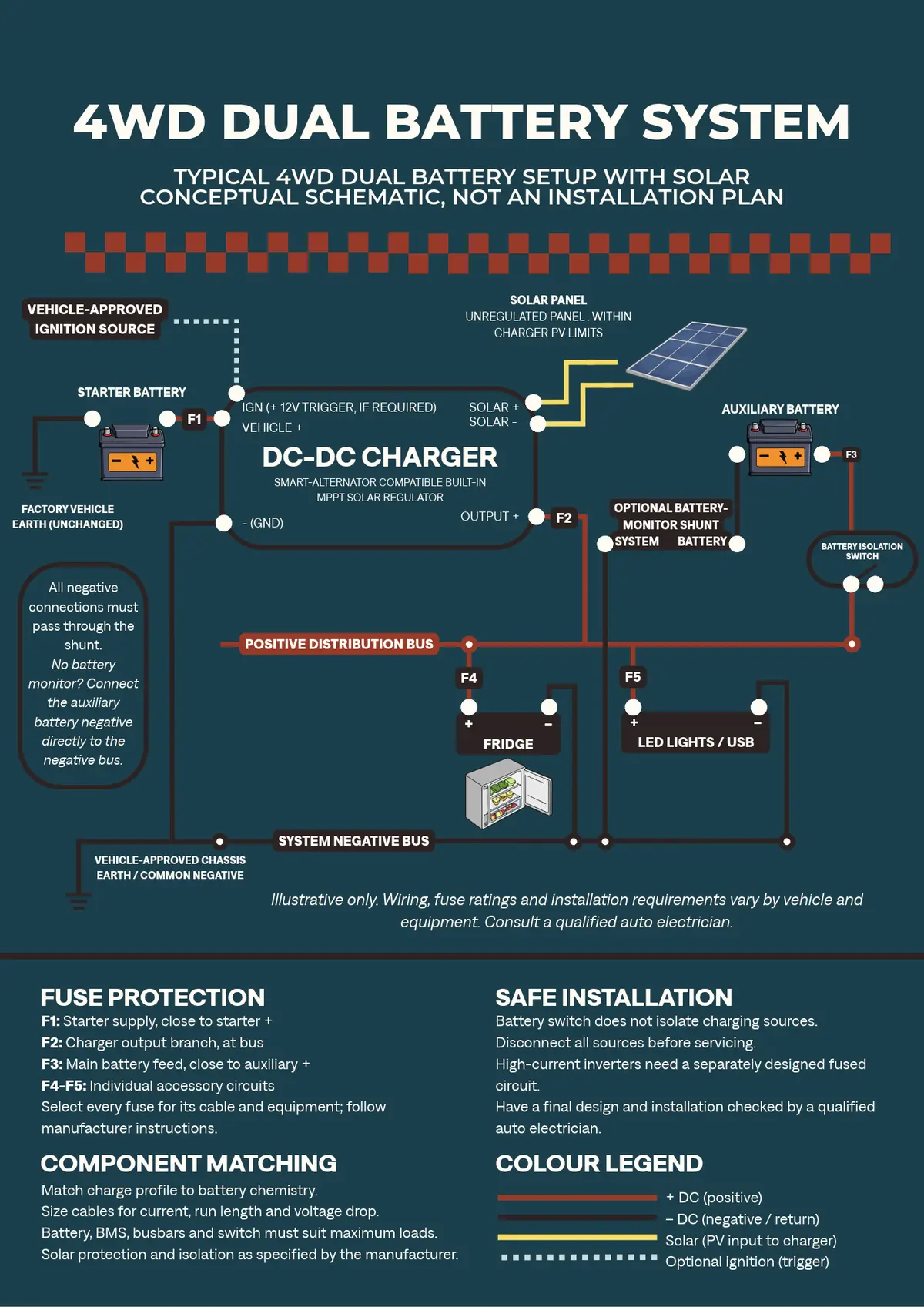
Diagram of a dual battery system for 4WDs
For the trailer or accessory connection, the Anderson plug is the standard in Australia. Our Anderson plugs explained guide covers sizing, polarity and fitting in detail.
Adding Solar
Solar keeps the auxiliary battery topped up when the engine's off, which is what extends a stay at a single campsite. The usual options are a fixed roof panel, a folding blanket you set out at camp, or a portable panel on a lead. Our comparison of solar blankets vs solar panels covers the pros and cons of each.
The important component is the MPPT solar regulator. Many DC-DC chargers include one, which keeps the system compact: solar and alternator input feed the same charger and the same battery. If your charger has no solar input, add a separate MPPT regulator wired directly to the auxiliary battery through its own fuse. Make sure it's set for your battery type, and that the panel's output does not exceed the regulator's limits.
What Goes Wrong
Most failures come from the same short list of faults:
- Undersized cable. Causes voltage drop, poor charging and heat. The charger may report a full battery that is not.
- No fusing, or the wrong fuse. A short circuit on an unfused cable can start a fire, and it can happen far from help.
- The wrong charge profile. Charging lithium with an AGM profile, or the reverse, shortens battery life and can leave it undercharged.
- Heat. Batteries mounted near the exhaust or in engine bays age quickly. Lithium cells can also be damaged by charging in the cold.
- Corroded or loose terminals. Resistance builds, heat follows, and connections fail on corrugations.
- A smart alternator and a VSR. The relay never closes properly, so the battery is never fully charged.
- Poor mounting. Batteries that move can short on metal, split cables or leak.
These are also the failure modes an insurer sees after a vehicle fire or electrical claim. A neat installation with correct cable, fusing and mounting is the best protection you can buy. Check your battery and connections regularly, especially after rough tracks.
The Short Version
- Use a DC-DC charger on any modern vehicle and with any lithium battery. A VSR still has a place on older vehicles with AGM.
- Choose lithium for weight and usable capacity, AGM for the lowest entry price.
- Size from your loads: daily amp hours, days off grid, usable capacity, plus a 20 per cent margin.
- Budget for cable, fusing and a proper install, not just the battery.
So, do you really need one? If you camp off grid regularly, run a fridge and want the starter battery protected, yes. If you do the occasional weekend away, a portable power pack is usually enough. Start with the loads you actually run, then pick the simplest setup that covers them with margin. Regardless, get out there, and free your 4WD.
The adventure starts where the bitumen ends
See how Club 4X4 can help