Words and Images by Marty Ledwich
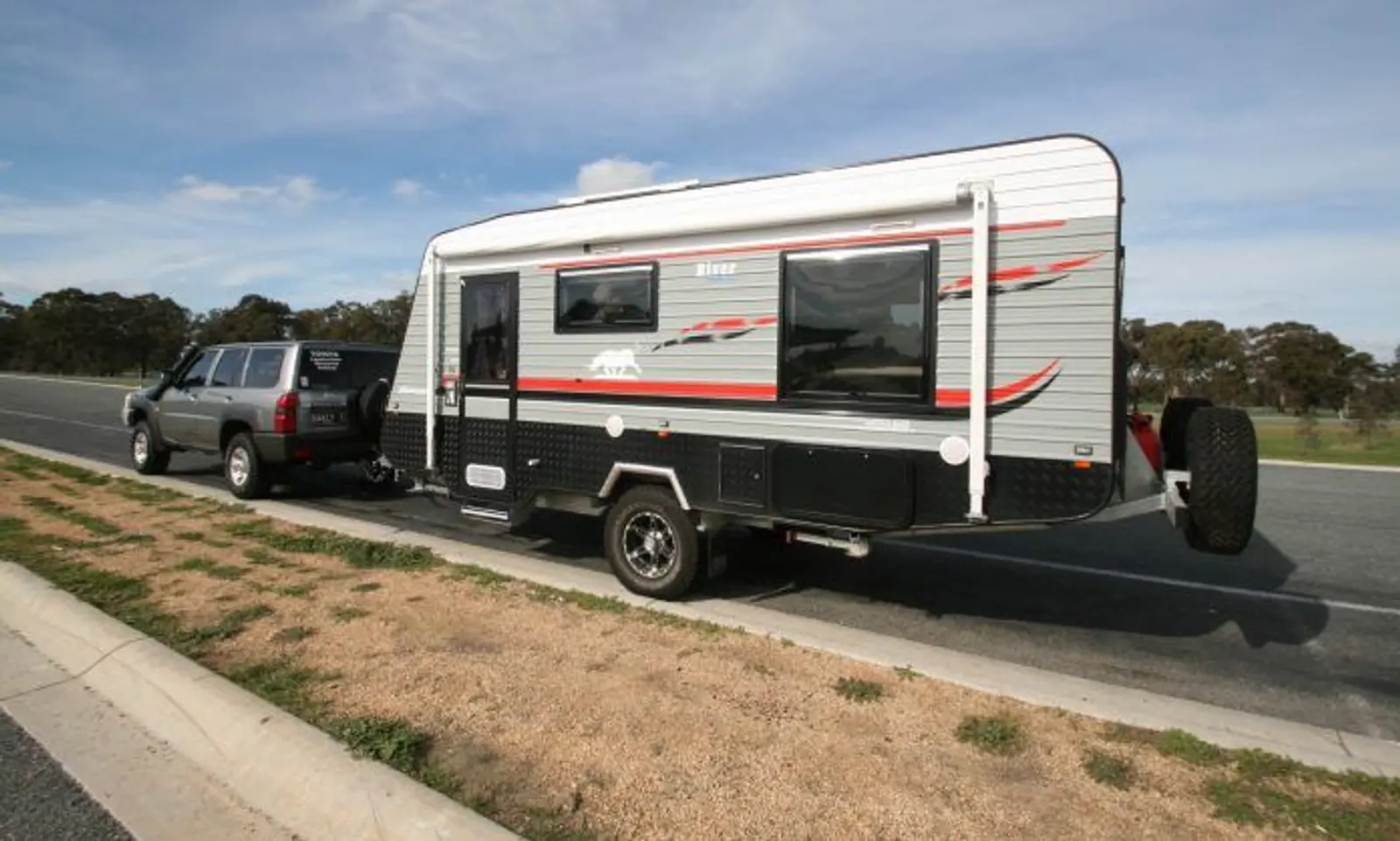
So….you’ve decided to do that big lap around the country and you’ve bought yourself a nice new caravan and a 4WD to tow it. You’re all loaded up with everything you and your family will need for the adventure of a lifetime. You’ve also been driving for most of your adult life and you’re confident you’re ready to set off, safe in the belief that you are compliant with all necessary laws and regulations.
But are you?
Here are seven laws that affect your driving when towing a trailer that you may have thought you knew but weren’t clear about or you may not have heard about them at all
1 – Driving too slowly
Many road users complain about caravanners driving too slowly and causing unnecessary traffic holdups. Some suggest that their slower driving is actually illegal. It is not illegal to drive too slowly, however, you can be booked for unreasonably obstructing drivers or pedestrians. All states will have their own road rule on this, however they will be largely consistent.
In Victoria the rule states:
1 A driver must not unreasonably obstruct the path of another driver or a pedestrian.
2 For this rule, a driver does not unreasonably obstruct the path of another driver or a pedestrian only because –
(a) the driver is stopped in traffic; or
(b) the driver is driving more slowly than other vehicles (unless the driver is driving abnormally slowly in the circumstances).
Example of a driver driving abnormally slowly:
A driver driving at a speed of 20 kilometres per hour on a length of road to which a speed-limit of 80 kilometres per hour applies when there is no reason for the driver to drive at that speed on the length of road.
In other words, you can drive at a speed that is safe and reasonable under the circumstances but doodling along at 20km/h on the freeway just to conserve fuel may land you in hot water.
2 – Break away brakes battery monitors
In all states of Australia, it is a requirement to have an electronic breakaway system with a back-up battery fitted to any trailer over 2000kg. What is not as well known is that for trailers registered in NSW, you must be able to monitor the battery from within the tow vehicle. The monitor must also have a visual and audible alert should the voltage of the battery in the system fall below operable levels.
3 – Prescribed height of a number plate
The Australian Design Rules (ADRs) 61/02 Vehicle Markings, Section 9.1.1.1. states:
…provision must be made for mounting a registration plate to be affixed to the rear of the vehicle so that no part of such plate is more than 1300 mm from the ground.
The registration plates on many larger off-road caravans and campers could potentially exceed this height restriction. It’s worth getting the tape measure out and ensuring yours is compliant.
4 – Articulated licence for a 5th Wheeler
If you were a resident of the ACT and you held a normal class C driver’s licence issued in the ACT, until recently you were not permitted to tow a fifth-wheel trailer. We even investigated with the appropriate department and were told this was true. *Now, apparently, the ACT Road Transport team has a changed its interpretation of Schedule 2 Part 3 Section 13(7) of the National Transport Commission (Road Transport Legislation – Driver Licensing) Regulations 2006. It no longer considers a fifth wheeler to be a semi-trailer.
5 – Speed limits while towing
Some states have differing speed limits for drivers towing a trailer regardless of where the driver originates. In NSW, if your rig’s combined weight exceeds 4500kg, the maximum speed you can do is 100km/h. In Tasmania, regardless of weight, it’s 100km/h. WA has a similar limit to NSW but does not specify a minimum weight. All other states allow driving with a trailer up to the posted speed limit.
Recent enforcement campaigns have highlighted that many towing setups exceed legal weight limits, particularly around payload and axle loads, so while knowing the speed limits is important, if you are overweight when assessed, it won't mean anything.
6 – Fitting towing mirrors
This one catches a lot of drivers out. A section of the ADRs, Vehicle Standard (Australian Design Rule 14/02 – Rear Vision Mirrors) 2006 specify that rear view mirrors provide a minimum field of vision as indicated by the diagram above.
Putting a full-size caravan on the back of your car will likely hinder vision of this area. So in order to remain compliant with the ADRs, you must fit extension mirrors. In Victoria, the offence for not doing so is fail to have a clear view of the road and traffic, ahead, behind and to each side of the driver and it will set you back $233.
7 – Do Not Overtake Turning Vehicle signs
While it is not a legal requirement to do so, if your vehicle (meaning the towing vehicle together with the trailer and projecting load) is 7.5 metres long or longer, you may fit a “DO NOT OVERTAKE TURNING VEHICLE” sign at the rear of the trailer. Under the Australian Road Rules – Reg 143 When passing or overtaking a vehicle displaying a do not overtake turning vehicle sign, a driver must not drive past, or overtake, to the left or right of a vehicle displaying a do not overtake turning vehicle sign if the vehicle is turning left and is giving a left change of direction signal, unless it is safe to do so.
This article was originally posted by RV Daily
Caravan packed and hitched?
Cover anywhere you can legally go in Australia