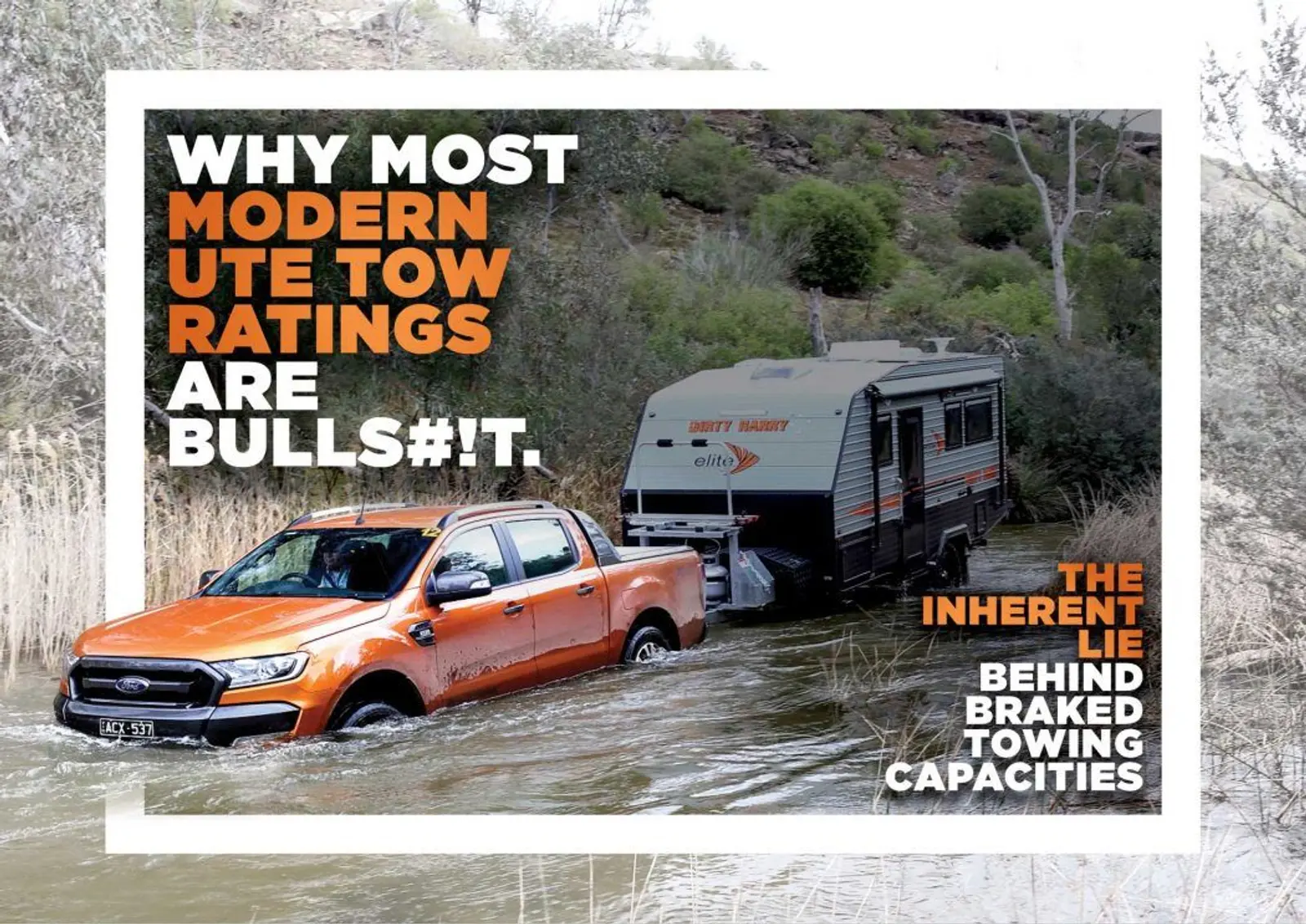
The inherent lie behind braked towing capacities.
We’re all being a little bit hoodwinked at the moment; led astray by 4WD manufacturers. It’s to do with the relevant tow ratings of vehicles, especially utes. It seems like all manufacturers are hell-bent to have a 3.5-tonne braked towing capacity, the problem is that they are all cutting corners to get there.
If you believe what they tell you in the advertising, these utes are all stronger than Steven Seagal’s stare, and can do just about anything tough – especially towing and hauling big loads. But not everything is as it seems, and it’s important to actually know the limitations of these vehicles.
Let’s have a look at the braked towing capacity figures, in order of 4X4 ute sales popularity. I’ll pick the highest-spec models (with diesel engines) to keep the field even.
Toyota HiLux SR5: 3,500kg (manual), 3,200kg (auto)
Ford Ranger Wildtrak: 3,500kg
Mitsubishi Triton Exceed: 3,100kg
Holden Colorado Z71: 3,500kg
Nissan Navara ST-X: 3,500kg
Isuzu D-Max: 3,500kg
Mazda BT-50: 3,500kg
Volkswagen Amarok: 3,000kg
Volkswagen Amarok V6: 3,000kg
Oh lord; I pity the fool that thinks that’s the end of the story. And I genuinely worry for the folk out there who don’t know any better and take the salesman at his word. When they ask, “Will this tow my caravan?” Put simply, Gross Combination Mass does not equal Gross Vehicle Mass plus Braked Towing Capacity. Let’s look at the rest of the specs, and understand what’s happening here. Now, where did I leave that old Casio calculator…
HiLux
Towing: 3,500kg (manual), 3,200kg (auto)
GVM: 3,000kg
GCM: 5,850kg
Kerb: 2,075kg
Payload: 925kg
Actual payload @ full towing: 275kg
Actual towing capacity @ full payload: 2,850kg
Ranger
Towing: 3,500kg
GCM: 6,000kg
GVM: 3,200kg
Kerb: 2,250kg
Payload: 950 kg
Actual payload @ full towing: 250kg
Actual towing capacity @ full payload: 2,800kg
Triton
Towing: 3,100kg
GCM: 5,885kg
GVM: 2,900kg
Kerb: 1,955kg
Payload: 945kg
Actual payload @ full towing: 830kg
Actual towing capacity @ full payload: 2,985kg
Holden Colorado
GCM: 6,000kg
GVM: 3,150kg
Kerb: 2,150kg
Payload: 1,000kg
Actual payload @ full towing: 350kg
Actual towing @ full payload: 2,850kg
Navara
GVM: 2,910kg
GCM: 5,910kg
Kerb: 1,969kg
Payload: 941kg
Navara towball penalty:100kg – 130kg
200kg – 280kg
300kg – 410kg
Actual payload @ full towing: 311-31kg (that’s not a typo, it’s 31kg)
Actual towing @ full payload: 3,000kg
D-Max
GVM: 2,950kg
GCM: 5,950kg
Kerb: 1,940kg
Payload: 1,010kg
Actual payload @ full towing: 510kg
Actual towing @ full payload: 3,000kg
BT-50
GVM: 3,200kg
GCM: 6,000kg
Kerb: 2,118kg
Payload: 1,082kg
Actual payload @ full towing: 382kg
Actual towing @ full payload: 2,800kg
Amarok
GVM: 3,040kg
GCM: 5,550kg
Kerb: 2,020kg
Payoad: 1,018kg
Actual payload @ full towing: 530kg
Actual towing @ full payload: 2,510kg
Amarok V6
GVM: 3,080kg
GCM: 6,000kg
Kerb: 2,216kg
Payload: 864kg
Actual payload @ full towing: 784kg
Actual towing @ full payload: 2,920kg
The problem is pretty obvious. It makes realistically trying to understand your legal limits here in the real world quite difficult. 3.5-tonne towing does not mean you can tow 3.5 tonnes. And a 1-tonne payload does not mean you can put a tonne in the back, if you’re towing.
A dishonourable mention here needs to be levelled at the Navara. Having a GCM that isn’t truly representative of a full payload and full towing capacity that sucks, in my opinion. But Nissan, taking it to the next level of limiting complexity with its towball mass clause, which could effectively give you a 31kg payload… that’s absolute rubbish. When you start factoring in extra passengers and accessories like barwork and canopies, things only get more dire. In fact, you even have to include the towbar most of the time.
Who is doing it right? Only Toyota’s 70 Series LandCruiser, these days. 3.5-tonne towing plus a 3.3-tonne GVM equals a 6,800kg GCM. The Land Rover Defender 130 had better stats at 3,500 + 3,500 = 7,000, but it’s sadly no longer around. Step up into the Light Truck category if you’re really serious and look at an Iveco Daily 4X4.
This article was originally posted by Unsealed 4X4.