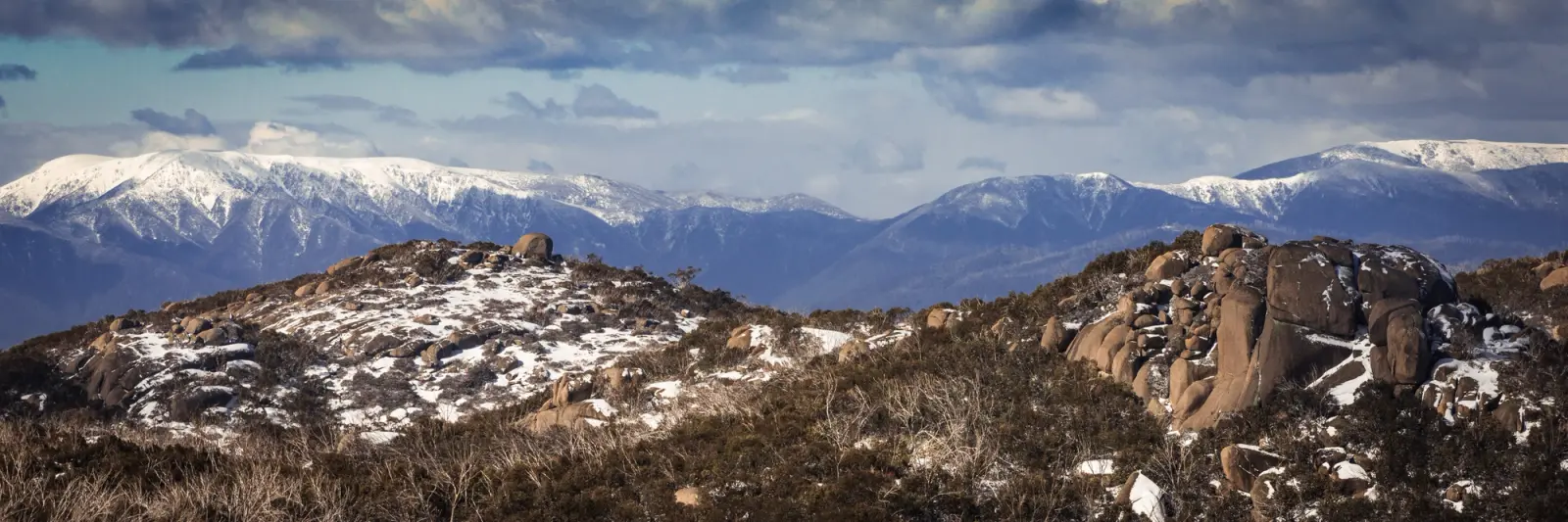
I’ve always found it slightly amusing that Australians will spend an extraordinary amount of money trying to avoid being cold, then the second somebody says there’s snow falling in the Victorian High Country, we’ll load $30,000 worth of camping equipment into a 4X4 and deliberately go and sleep in it.
I’m absolutely one of those people.
There’s something genuinely special about camping in the High Country when the snow comes down. Places you’ve visited a dozen times suddenly feel completely foreign; the usual browns and greens disappear beneath a layer of white, snow gums look like somebody has decorated them for Christmas, and the silence that follows a decent snowfall is unlike almost anything else you’ll experience in the Australian bush.
Then there’s the simple stuff. A fire feels warmer, coffee tastes better and cooking bacon at seven in the morning somehow becomes an achievement worthy of recognition from the Governor-General. Even scraping ice off the windscreen is enjoyable for approximately the first 40 seconds, because you’re standing there thinking, look at me, camping in the bloody snow.
It is one of my favourite ways to experience the Victorian High Country, but there’s an important qualification attached to that statement: snow camping is magnificent when you’re prepared for it. Get the preparation wrong and the beautiful white stuff falling outside your swag rapidly becomes frozen water specifically designed to make everything you own wet, cold and miserable.
The good news is that you don't need to be Sir Edmund Hillary or related to Shackleton to do it properly.
High and low
We cover anywhere you can legally go in Australia
Your First Snow Camp Shouldn't be an Expedition
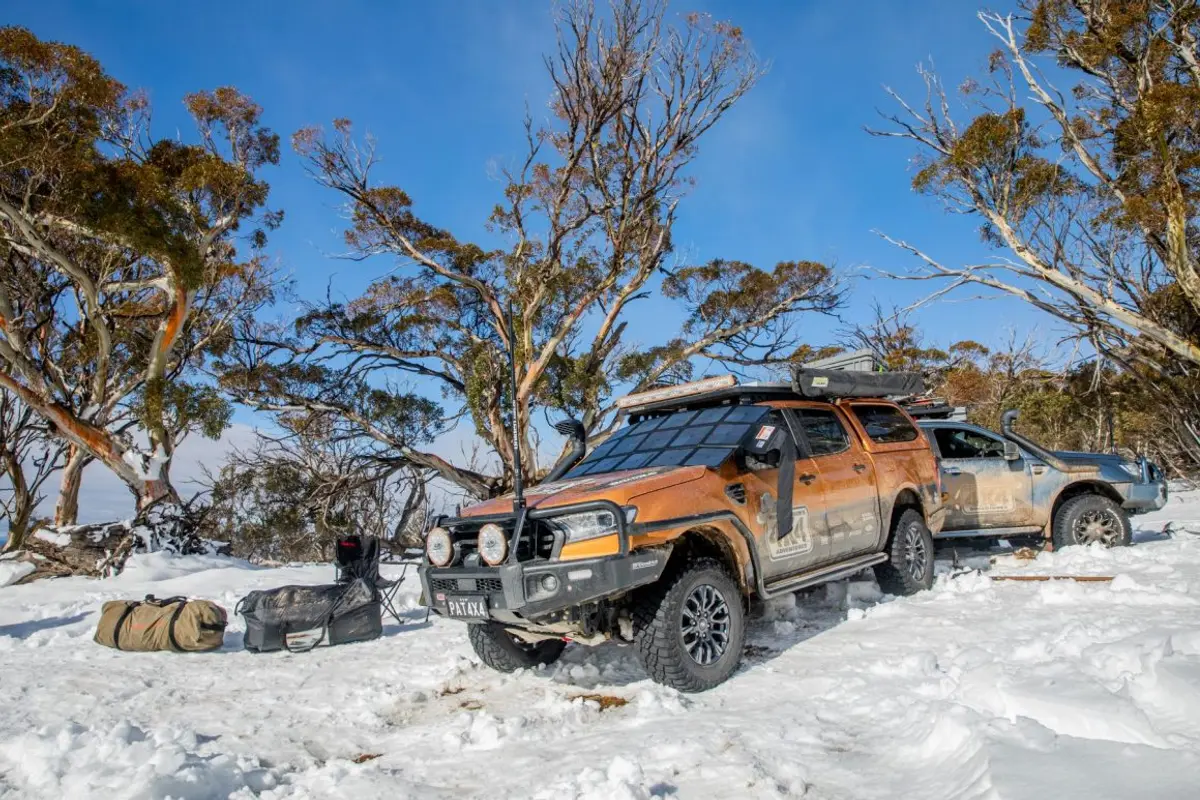
Setting up camp in snow in the Victoria High Country, 4WDing
If you've never camped in snow before, resist the temptation to make your first attempt the most remote, difficult trip you can possibly devise. Winter access throughout the High Country is significantly reduced by seasonal road closures, with many roads and tracks closing after the King's Birthday weekend and remaining closed until around the end of October. Those closures exist both for public safety and to prevent vehicles destroying softened tracks.
That actually creates an important distinction people sometimes miss: snow camping doesn't necessarily mean snow-wheeling.
You can choose a legal, accessible campsite around the lower fringes of the alpine country, watch the forecast and time your trip around snowfall. In fact, for your first attempt, that's exactly what I'd recommend. You want enough snow to transform the landscape and give you the experience, without requiring a helicopter to explain to the evening news why you've become temporarily attached to a mountain.
Before leaving, check Parks Victoria for closures and current conditions, check VicTraffic, check the weather at the actual elevation you're travelling to and have a Plan B. At the time of writing, several well-known high-elevation routes including Blue Rag Range Track and Dargo High Plains Road are closed until the seasonal reopening period.
A closed gate isn't an obstacle in your adventure. It's the end of that route.
Being Cold Isn't Usually the Problem. Being Wet is.
Most people preparing for their first snow camp focus entirely on temperature, but moisture and wind are just as important. Zero degrees in dry clothes with good insulation can be remarkably comfortable; five degrees when you're wet and standing in a stiff wind can be absolutely bloody miserable (ask me how I know).
Rather than relying on one enormous jacket that makes you look like you're about to climb Everest via the Bunnings sausage stand, dress in layers. A good thermal base layer manages moisture, an insulating mid-layer traps warmth and a waterproof, windproof outer layer keeps the weather where it belongs.
The clever bit is actually using those layers properly. If you're setting up camp, collecting firewood or digging somebody's vehicle out and you're beginning to sweat, take a layer off. The moment you stop working, all that moisture you've enthusiastically manufactured inside your clothing starts cooling you down (‘cause… that’s what it’s ‘sposed to do).
Pack spare socks and gloves in a genuinely waterproof bag, not somewhere that you describe as "pretty waterproof". There is a substantial difference between those two concepts at 9pm when your only pair of gloves has the thermal properties of a Chux cloth that’s been in sitting in dry ice.
Don't Spend $600 on a Sleeping Bag and $40 on the Thing Underneath it
This catches people out constantly.
You buy a magnificent sleeping bag rated to temperatures usually associated with penguins, climb into it feeling exceptionally prepared and then spend the entire night wondering why your backside is freezing.
Your sleeping bag isn't the whole sleep system. The ground underneath you will steadily rob heat from your body, which is why an insulated sleeping mat with an appropriate R-value is so important in cold conditions. A quality cold-weather mat and sleeping bag need to work together.
When comparing sleeping bags, pay attention to the comfort rating, not simply the most impressive negative number printed on the tag. The lower-limit and extreme ratings aren't necessarily temperatures at which you're going to have a lovely eight hours and wake refreshed. One of them can be considerably closer to "you probably won't die", which I personally consider a fairly low standard for accommodation.
I also keep the next morning's clothes inside the tent or swag, dry and relatively warm by stuffing them inside my sleeping bag at night. Putting on frozen pants at sunrise undoubtedly builds resilience, but at this stage of my life I feel I've developed enough resilience.
JL PRO TIP: If you’ve got an electrical setup, invest in a 12V heated blanket. They drink as much power as a barn mouse and keep you warm all night long.
The Four-wheel Drive Doesn't Make You Invincible
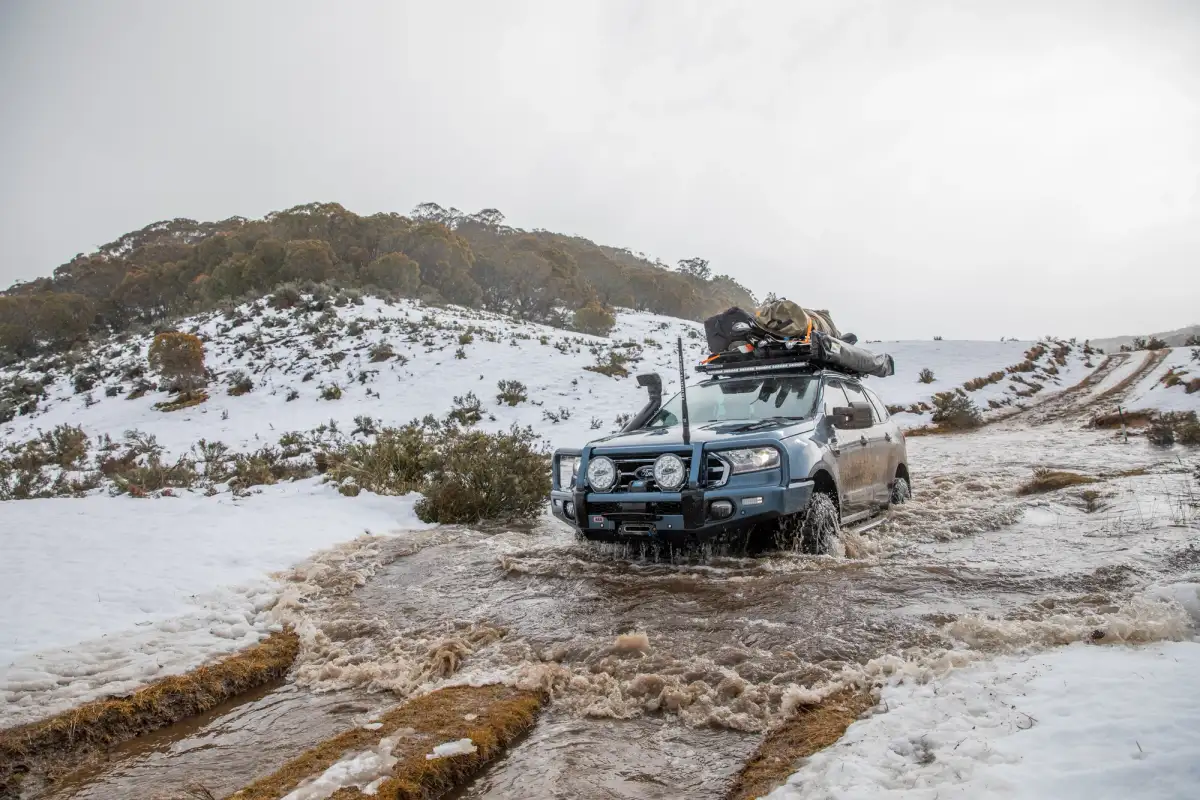
Ford Everest driving through water in the Vic High Country
Snow is one thing; ice is another entirely.
Black ice can be extremely difficult to see and commonly forms on shaded roads, particularly early and late in the day. I’ve lost count of the amount of accidents I’ve witnessed in Alpine Country. If conditions are icy, slow everything down: acceleration, braking, steering inputs and your expectations of what the vehicle can do. Victoria Police specifically advises gradual acceleration, gentle braking, increased following distances and low gears on descents in alpine conditions.
Four-wheel drive helps distribute drive to more wheels. It doesn't repeal physics when you touch the brake pedal.
Your preparation should include good tyres, recovery equipment, a compressor, shovel, additional food and water, warm clothing, first-aid equipment, communications and enough supplies to comfortably stay longer than planned. Tell someone where you're going and when you expect to return, particularly if you're heading somewhere remote.
Snow chains deserve particular attention. If you're entering a Victorian alpine resort during the declared snow season, carrying suitable wheel chains is mandatory, including for four-wheel drives, and you must fit them when directed. Even outside that specific requirement, Parks Victoria recommends vehicles travelling to some High Country camping areas carry snow chains and recovery gear.
More importantly, practise fitting them at home.
The side of an alpine road, in sleet, with numb fingers and your mate holding a torch in exactly the wrong direction, is an exceptionally poor classroom.
Camp Like You Want to Come Back
Snow doesn't make the normal rules of responsible camping disappear. If anything, winter conditions make your impact easier to underestimate because the ground you're damaging may be hidden underneath it.
Use established campsites where required, obey track closures, don't create new routes around bog holes or fallen trees and take your rubbish home. If a track is saturated and you're destroying it simply by progressing, consider whether progressing is actually necessary. Parks Victoria's winter closures specifically exist because rain and snow soften tracks and make them vulnerable to erosion and vehicle damage.
Fire also needs some thought. Check the rules for wherever you're camping, use existing fireplaces where required and don't assume you'll simply arrive and collect perfectly dry firewood from beneath six inches of snow. I like carrying enough dry kindling to get things established, because discovering every stick within 500 metres has the moisture content of a cucumber is another lesson you generally only need once.
And never rely entirely on a campfire for warmth. Your clothing and sleep system should be capable of keeping you safe without one.
It's Worth the Frozen Fingers
None of this is intended to make snow camping sound frightening. Quite the opposite.
With decent preparation, conservative decision-making and the right equipment, it is one of the most achievable ways to turn a familiar Victorian camping trip into something that feels like a genuine expedition.
That's the wonderful thing about the High Country in winter. You don't need to conquer anything.
You can find somewhere legal and accessible, set up properly before dark, cook dinner while snow settles on the four-wheel drive and sit beside the fire watching a landscape you've known for years completely transform around you.
Then eventually you'll climb into a warm sleeping bag, listen to snow landing softly on the canvas and wonder why you don't do this more often.
At approximately 6:30 the following morning you'll discover your boots are frozen solid, your windscreen resembles a Streets Paddle Pop and somebody needs to leave the sleeping bag to make coffee.
At which point you'll remember exactly why.
And then you'll do it again next winter.
High and low
We cover anywhere you can legally go in Australia