Start With How Much Power You Use
Caravan solar gets sized backwards by most people. They buy the panel that fits the roof and then wonder why the battery is flat by day three. Start with consumption instead.
Add up what draws power over a typical 24 hours, in amp hours at 12 volts. The usual suspects:
- A 12V compressor fridge, the biggest load in almost every van: roughly 30 to 60 amp hours a day depending on size, ambient temperature and how often the door opens.
- Lights, water pump and fans: 5 to 15 amp hours.
- Phone, tablet and laptop charging: 10 to 20 amp hours.
- A diesel heater, if you have one: 10 to 20 amp hours on a cold night.
- An inverter running anything with a heating element or a motor: potentially a lot. A coffee machine or a toaster can pull 20 amp hours in a few minutes of use.
A typical couple in a modern van lands somewhere between 60 and 100 amp hours a day. That's the number the solar has to put back.
How Much Solar That Takes
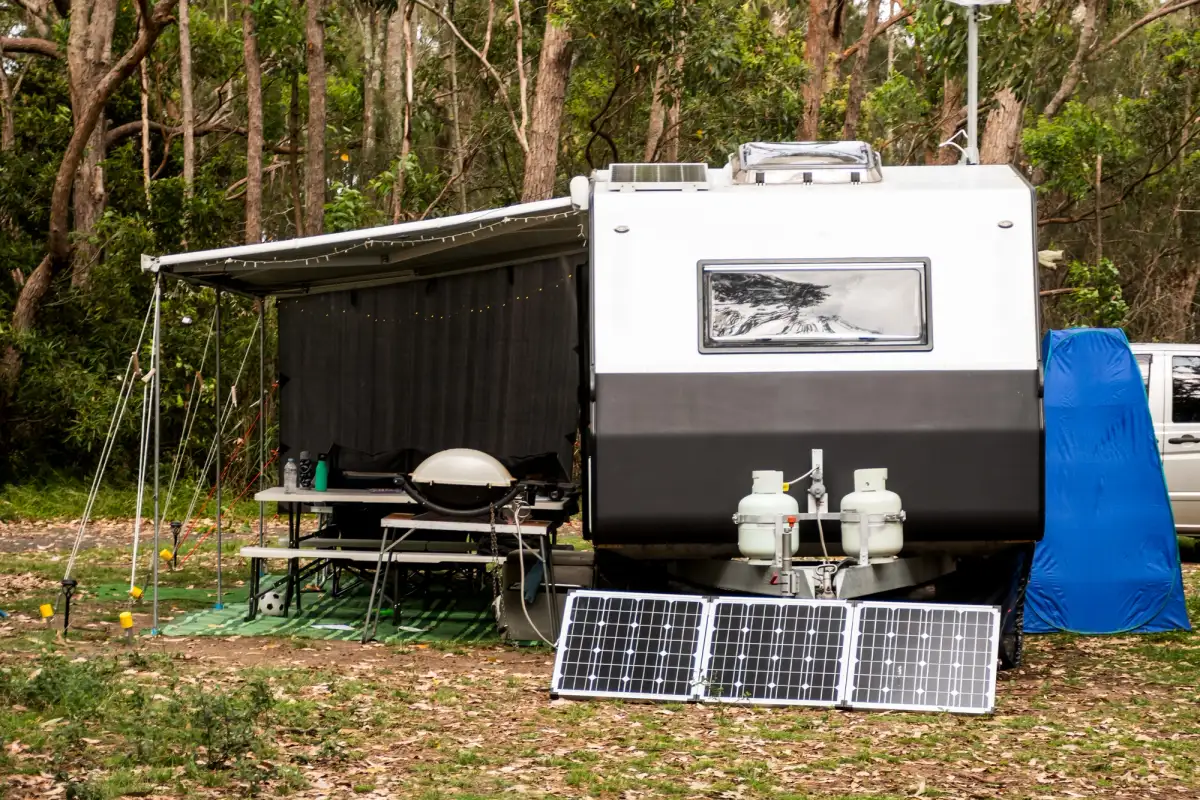
A caravan at a campground with a solar panel set up
A solar panel's wattage is its output in perfect conditions, which you will not have. In Australia, a reasonable planning figure is four to five hours of equivalent full sun a day in summer, closer to three in winter in the south. A 200 watt panel at 12 volts nominally makes around 11 amps in full sun, so over four and a half hours it returns roughly 50 amp hours on a good day. Shade, dust, heat, a flat mounting angle and cloud all take a slice.
Most caravans used for off-grid travel need between 300 and 600 watts of solar, depending on daily power consumption. A typical couple uses 60 to 100 amp hours of power per day, largely from a fridge, lights, charging devices and appliances. To stay self-sufficient, your solar system must replace that energy each day, with battery capacity and regulator efficiency also playing a major role.
Working from that, a van using 80 amp hours a day wants 400 watts or more of panel to keep up without driving. Many people run 300 to 600 watts on the roof and carry a portable panel or blanket for shaded sites. If the number feels big, that's normal. Undersized solar is the most common fault in caravan 12V systems.
Roof Panels Versus Portable
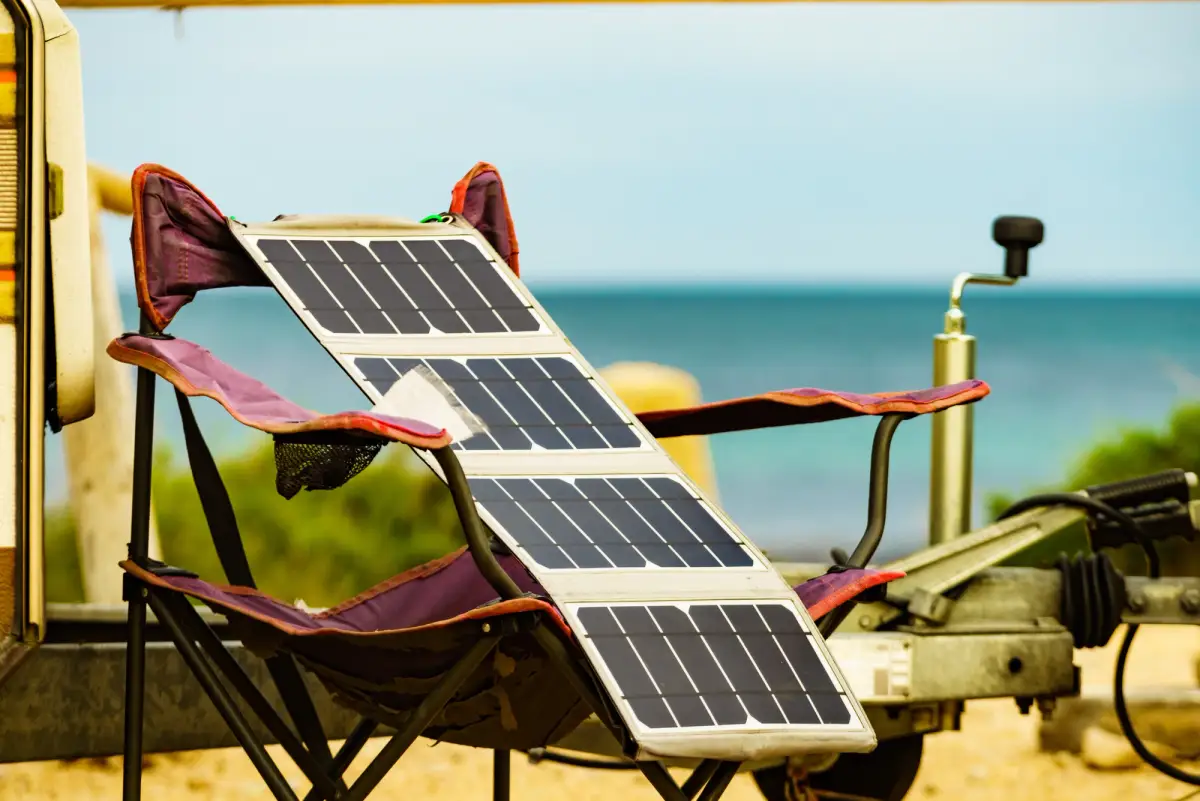
Portable solar panel on a camp chair
Roof-mounted panels work whenever the sun is up without any effort, and that counts for a lot. The trade-off is that you park where the shade is and the panels are where the van is.
Portable panels and solar blankets go where the sun is. You can park the van under a tree and run the blanket out into the open. They also get stolen, need to be packed away, and are one more job at camp. Most experienced tourers run both: as much on the roof as will fit, plus a portable for the days it's not enough.
PWM Versus MPPT Regulators
The regulator sits between the panel and the battery and controls the charge. There are two types.
A PWM regulator is simple and cheap. It connects the panel to the battery and switches it on and off to control the charge. The panel is pulled down to battery voltage, so a proportion of its potential output is wasted, typically 15 to 30 per cent.
An MPPT regulator tracks the panel's most efficient operating point and converts the surplus voltage into extra current. It costs more and harvests noticeably more power from the same panel, especially in cool weather and with higher-voltage panels. For anything over about 200 watts, MPPT is worth it. For a small portable panel on a budget, PWM is fine.
Many modern DC to DC chargers have an MPPT solar input built in, which lets one unit handle both alternator charging while driving and solar at camp, and removes a separate regulator from the system.
Solar, lithium and the van itself, covered
Caravan insurance with fitted accessories declared and included in the agreed value.
Battery Chemistry Changes the Maths
Solar is only useful if there's somewhere to put it. A lead-acid or AGM battery can only be run down to around half its capacity before it suffers, so a 100 amp hour AGM gives you about 50 usable. A lithium battery of the same size gives you 80 to 90 usable, charges faster and takes everything the solar can throw at it. If you're upgrading the solar, the battery is usually the next conversation, and we compare the two in how much 12V battery power you really need.
Wiring, Fusing and the Plug on the Drawbar
Three things trip people up on the install.
Cable size. Solar runs at low voltage and the current adds up. Undersized cable between roof and regulator loses output as heat. Use the size the regulator manufacturer specifies, and run it short.
Fusing. The cable from the regulator to the battery needs a fuse at the battery end. The panel side should have a breaker or fuse too, which also gives you a way to isolate the panels while working on the system.
The vehicle connection. If the van charges from the tow vehicle while driving, that feed arrives through an Anderson plug on the drawbar and should go through a DC to DC charger in the van, not straight to the battery. Portable panels often use the same plug, so label which is which.
Keeping it Working

A man wiping down solar panels on the roof of a caravan
Panels on a caravan roof get filthy. Dust, bird droppings and red dirt can cut output by a third. Wipe them down when you wash the van. Check the mounting feet after corrugations, because panels do come off. Watch the regulator's display for the daily harvest figure so you notice when something is wrong before the battery is flat. And if the system has worked for years and suddenly stops keeping up, check the battery before blaming the panels.
For the bigger picture on setting up a van to stay out longer, our articles on the off-grid power setup and the ideal off-grid camp carry on from here.
Where it Fits with your Insurance
A proper solar and lithium setup on a caravan can easily be worth $5,000 or more, and it's fixed to the roof of something that travels on corrugated roads. Club 4X4's caravan insurance and camper trailer insurance let you declare fitted accessories so they are included in their own agreed value. List the panels, regulator, battery and inverter with their values, keep the receipts, and update the figure when you add to the system.
The adventure starts where the bitumen ends
See how Club 4X4 can help