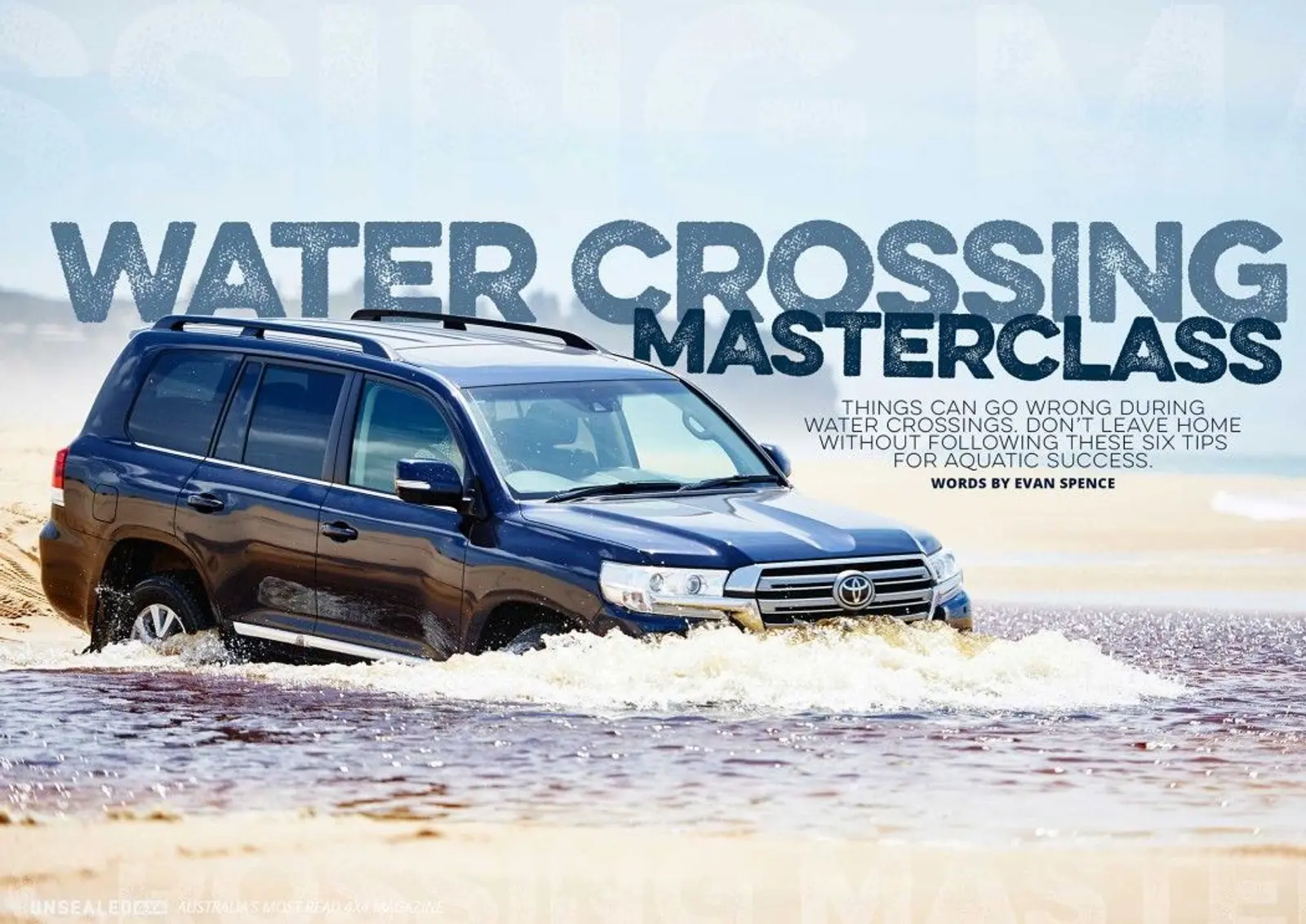
Water crossings are fun, simple as that. But the potential for things to go wrong can actually be rather high if you are unprepared or out of your depth… pun intended. You are dealing with potential submerged objects, deep pockets of water and strong currents in some cases. By blindly leaping through any crossing, you are putting your vehicle and passengers at risk of harm. Now, we don’t want to sound all doom-and-gloom here; but before you attempt to drive through any water crossing, it is always advisable to follow these six tips. Choose to ignore this advice at your own peril.
1 WALK THE CROSSING
It sounds obvious, but wherever possible walk the crossing before attempting to drive it. By walking the path you wish to follow, you are gaining two important pieces of information. Firstly, you are determining if there are any submerged objects such as rocks, logs or deep holes to avoid. Secondly, if you can’t walk the river crossing due to depth or fast-flowing current, chances are you won’t be able to drive it either. Now, there are some exceptions to this rule … such as walking through croc-infested waterways or through a flooded road (which is something I’d never advise). I also wouldn’t ever recommend driving across a flooded road, as history has proven time and time again how dangerous this can be.
2 WEAR A WATER BLIND
Vehicle manufacturers will claim a maximum fording depth in their new vehicle brochures, which is all well and good. But without a measuring stick handy (I’ve never seen one in the bush) how can you guarantee you are within factory tolerances when approaching a crossing? Fitting a water blind takes just a few minutes, and prevents a sudden gush of cold water entering your vulnerable and warm engine bay while crossing a river. There are two options here: You can pop into a four-wheel drive store and buy a water blind or water bra kit over the counter for a nominal fee; or if you are so inclined a home-made version using a tarp and some small ratchet straps will also work. But please, don’t use Ocky straps … your eyes will thank me for it.
3 FIT A SNORKEL
You can’t breathe underwater, and neither can your four-wheel drive. A snorkel is a sure-fire way to protect your air intake from potentially swallowing a harmful gulp of water. Now, I say ‘protect’ here, not ‘guarantee’. Fitting a snorkel does not convert your vehicle into a submarine – so care still needs to be taken when judging water depths. While older mechanically injected diesel engines will run under water with a fully sealed snorkel, thanks to their lack of electrical components and no reliance on spark, how many people are still driving old 2H powered LandCruisers these days? Modern diesel engines have a fierce reliance on electronics, with a myriad of sensors mounted in and around the vehicle. If I remember just one thing from my high-school science classes, water and electricity don’t mix.
4 CREATE A BOW WAVE
By creating a bow wave in front of your four-wheel drive during water crossings, you have pushed the deepest bodies of water forward and away from your vehicle. A good thing! Basically, you want to see a small wave appear in front of your vehicle – something that resembles a Hawaiian barrel wave, just on a much smaller scale. We aren’t saying hit the water crossing at Mach 5 as they do in some off-road publications (and on new vehicle commercials); quite the opposite, actually. A gentle amount of momentum is the best way to describe the driving technique required here. It takes some practice, but you will get a feel for it. If water is blanketing over your bonnet, and the crossing is only knee deep … you are going too fast.
5 CHOOSE THE RIGHT GEAR
I’m not talking about the right brand of tyres or suspension here, even though they are important. Nope, I’m referring to selecting the right gear in your vehicle’s transmission and transfer case, as well as any specific terrain response modes (if applicable) on your four-wheel drive. The rule-of-thumb has been second gear low range, and a suitable amount of momentum. However, I don’t agree that this technique works in all situations. Most yes, but not all. For example, on my family farm there is a shallow crossing with a rocky bottom. First gear low range works all the way here – as you want absolute control over these mini boulders. Also, as modern four-wheel drives are appearing with 8-speed transmissions, second gear could be too low. Experiment in a safe environment, and if even slightly unsure, book in for a four-wheel drive course and gain confidence in a controlled environment.
6 WAIT IT OUT
Now here is a new motto for you: If in doubt, wait it out. Rivers can be influenced by tides, or there could be a sudden and heavy downfall further upstream boosting water flow. So while a water crossing might be fast flowing and too deep to drive in the morning, it could drop dramatically in just a few hours. Recreational four-wheel driving is just that … recreational, a hobby. If you aren’t in a competition environment in a purpose-built buggy, or a life-threatening situation, pop on the kettle and relax for a few hours to best assess the situation. This also gives your vehicle a chance to cool down before taking the plunge. If things aren’t improving, seeking a safer alternative route is the best option. It isn’t worth the risk to you, your family and your vehicle to proceed blindly (knowing full well it isn’t the smart thing to do).
Words by Evan Spence