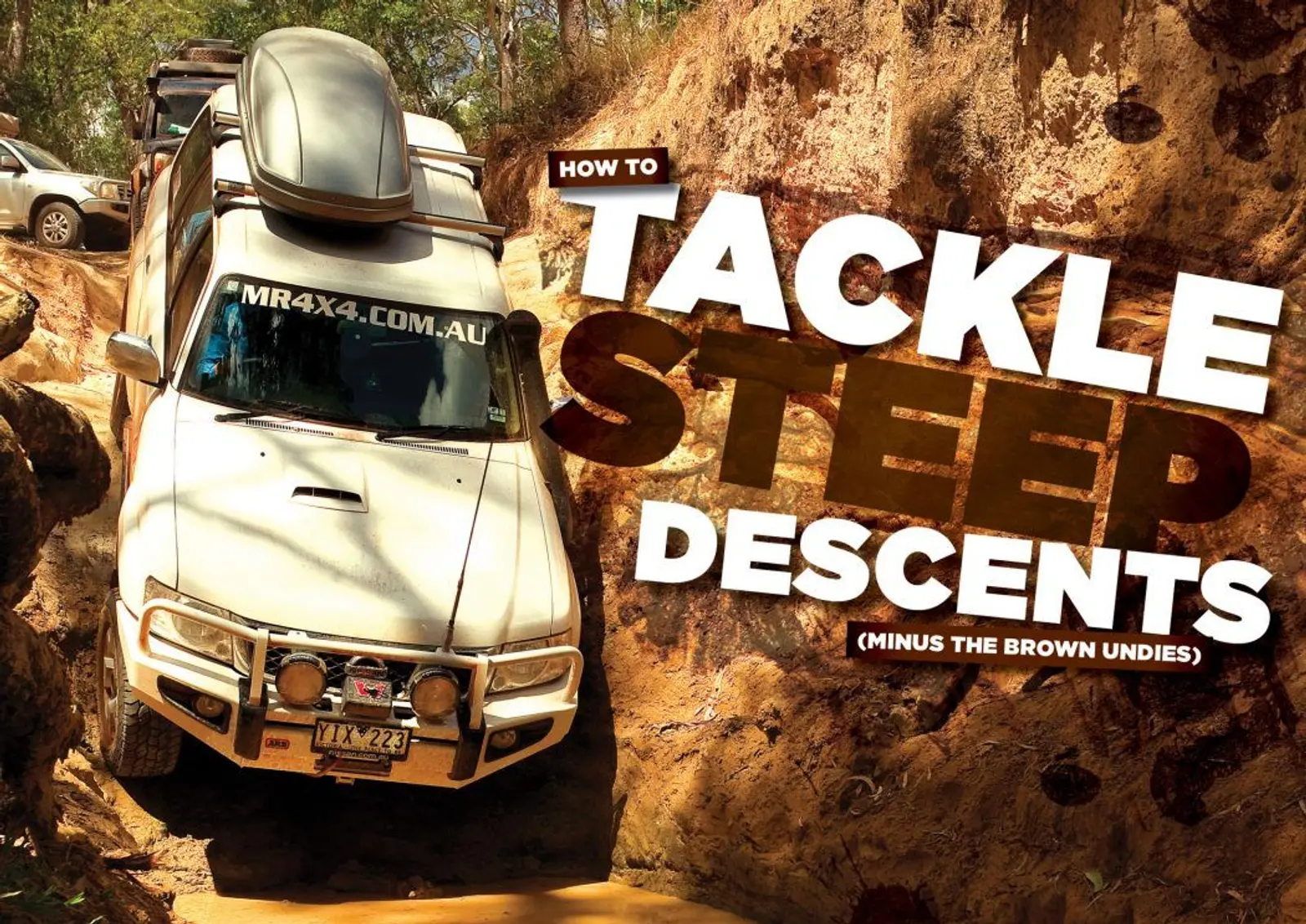
Sooner or later you’re going to come across a steep hill that you’re going to need to drive down. It’s simply a fact of life when driving off-road. The nose of the vehicle drops down and the back end rises sharply. You’d swear blind that you’re only a couple of degrees off full vertical. The pucker factor is at eleven, your heart rate is higher than Clive Palmer’s when he’s climbing a set of stairs and you stopped breathing several seconds ago. It can be pretty nerve-wracking.
But there are a few techniques you can employ to ensure you make it down safely. Sure, most of them are common-sense sorts of things but it always helps to have a bit of a mental checklist when faced with these types of obstacles – so here is our guide to getting down a steep hill without damaging yourself or your vehicle.
ASSESS THE LINE
As you idle up to the top of the descent, get out and have a quick look at any things that’ll unstick you on the way down. If you can’t walk down it safely then the chances are you won’t be able to drive it risk-free either. Make a mental note of any deep ruts or anything that may be lying in wait to damage your panels or underbody (like tree roots or rocks).
Choose your line, too. The name of the game is traction, and keeping as much as you can as you come down the slope. The general rule is that if you can stick to the ruts, do so. They’ll keep you on line and will often have the best amount of traction available for your tyres.
MAKE SURE YOUR VEHICLE IS READY
It may sound obvious… but first gear, low range and feet off the pedals. If you have an auto (which is most people these days), then manually shift into low gear and flick the torque converter lock up (if you have one installed). Even then, your 4X4 may still want to go down the hill faster than you’re comfy with – so you may need to apply what’s called ‘cadence braking’. This basically involves you dabbing the brake pedal on and off fairly rapidly as you head down. It’s essentially the same thing as what your ABS does. It arrests the vehicle momentum without locking the wheels up and causing a slide. It takes a bit to get the hang of, but if you practice on a gentler slope first then you’ll get the gist of it in no time… and it’s a useful skill to have.
As for downhill descent control – some 4X4s have better systems than others, so again have a bit of a play on a gentler slope first. Some vehicles will take the guesswork out of it for you and perfectly glide you down to the base of the slope. Others will make you think that they accidentally installed a washing machine under the bonnet instead of an engine and have you wondering if your fillings are about to pop out.
Regardless, it’s always a good idea to know how to drive a descent without electrical assistance. Oh (and again, not to state the obvious) make sure everything in the back of the vehicle is well secured. The last thing you want is your Esky flying forward and smacking you in the back of the melon.
OKAY, TIME TO DRIVE IT
Remember, you ideally want to head down the slope with the engine doing the braking for you, your feet clear of the pedals and you just concentrating on sticking to your line (the straighter down it is, the better). Here’s where experience and technique play a big part. Let’s say you’re on a slippery muddy decline. You’ve just started the drive down and you feel your rear end start to slide, trying to overtake your front end. This is rollover territory. Gravity is working against you.
Your natural reaction is going to be wanting to stomp on the brakes, but this will actually only make the situation worse. The trick is to gently (repeat: GENTLY) apply some throttle and adjust your steering into the skid. This will bring the back end into line. Yes, you’ll now be travelling a little faster than you were before; but you’re holding your line and even though it may not feel like it you’re not really going to get much speed up thanks to the low gearing. When you feel it’s safe, ease back off the throttle and let gravity work for you again – taking you to the bottom safely. Of course, some slopes are just too dangerous to drive…
WINCHING DOWNHILL… NOT AS DUMB AS IT SOUNDS
Doesn’t sound right, does it? Usually you’d use a winch to pull you up something, not down; but it’s actually a handy technique if the terrain is ridiculously treacherous. Instead of nosing your way up to the decent, reverse up and run your winch out to the nearest sturdy anchor point. Spool the winch out to lower yourself slowly down the slope, making sure to keep everyone well clear (unlike the guy with the death wish in the video). If you have enough length, a double-line spool-out will make things even more controlled. While it’s not a technique that will serve in every scenario, it can be a good ace up your sleeve if the terrain is really severe.
Article From Unsealed 4×4