
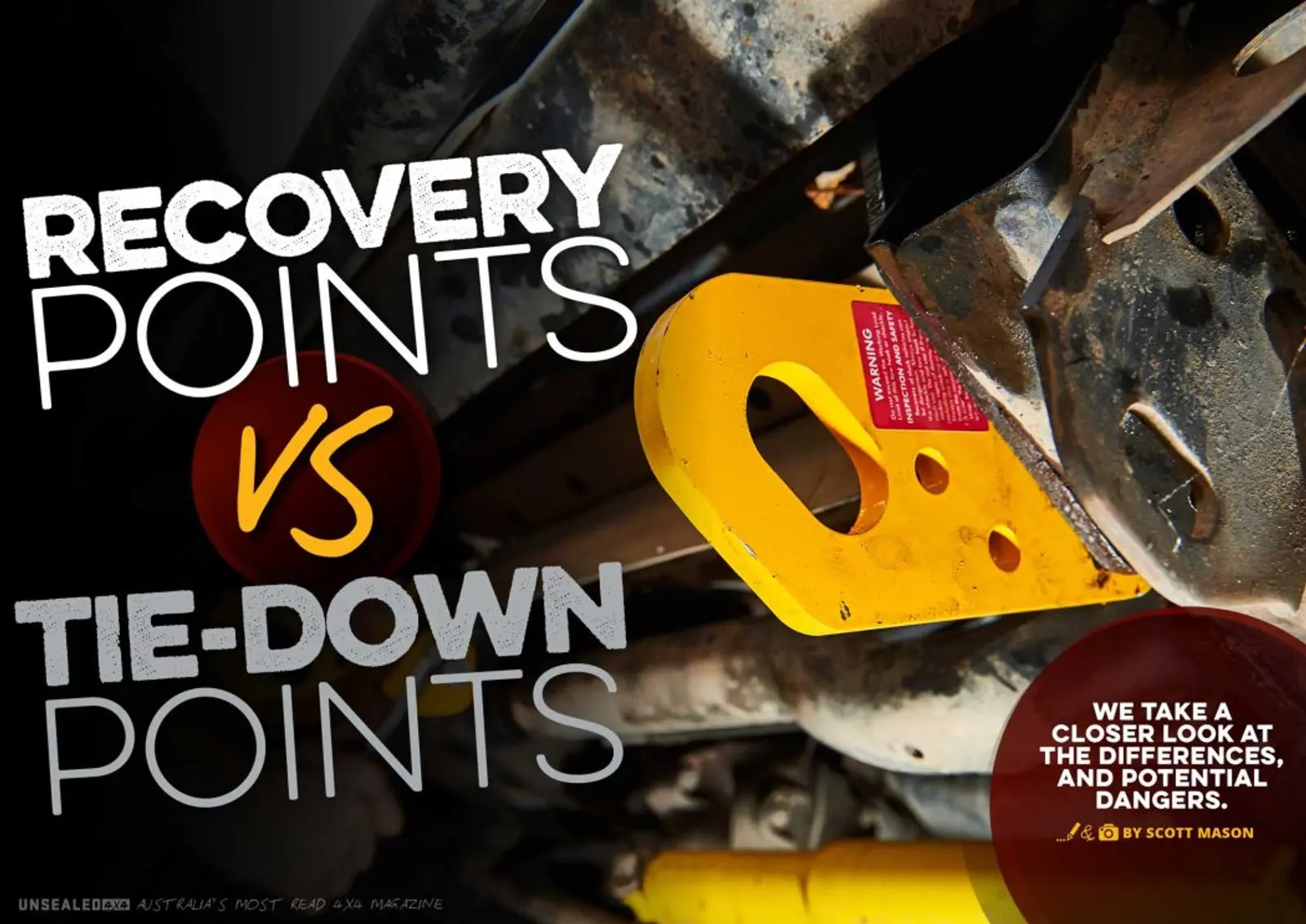
We take a closer look at the differences, and potential dangers.
Unless you have been sleeping under a rock you will have noticed that we are pretty passionate about making sure you guys are armed with, at the very least, the basic knowledge for safe recoveries. While we cannot convey all you would learn in an accredited off-road course, we aim to give you a basic guide for safety’s sake. It really is something that we all care about because, at the end of the day, a fun trip away can end in disaster if a recovery goes wrong. Simple as that.
By now you may have heard of ‘rated’ recovery points. Well this is possibly somewhat of a misnomer. What we are referring to are factory-fitted or aftermarket purpose-built points that are chassis-mounted and designed for the sole purpose of being used as attachment points in a recovery situation. NOT a factory tie-down point – which is fitted by the manufacturer and has the sole purpose of securing a vehicle to the floor of a shipping container or transport vessel. Tie-down points are definitely not designed for (or capable of) enduring the forces exerted in a vehicle recovery.
So what are the differences? And how do we distinguish a factory tie-down point from a factory recovery point? Also, why is a ‘rated’ recovery point a bit of a misnomer? Read on…
What exactly is a ‘Rated’ recovery point?
It is generally accepted that a ‘rated’ recovery point is a fixture that is generally mounted to the chassis with bolts, gusseted welds, or a combination of both. Its sole purpose, whether it is aftermarket or factory, is to be used as an attachment point for recovery situations. That is, to accommodate a shackle, which subsequently may be subjected to both longitudinal and latitudinal pulling forces.
The ‘rated’ part, however, gets confusing. There is currently only one car manufacturer (Land Rover) that has done the extensive testing required in order to determine actual weight or force ratings for recovery points. Similarly there are only two aftermarket recovery point manufacturers that provide ratings. Why is this?
Well, the thing is, there are no set rules when it comes to the forces involved in a recovery. Let’s look at a ridiculous example and you will see why. A 3-tonne truck is stuck 800mm deep in glutinous clay. A strap is attached to purpose-built recovery points and also to a 5-tonne truck that passes by at 80km/h (like I said, ridiculous, but let’s play this out). Logic and Newton’s second law of motion (force equals mass times acceleration) tell us that something will break before the truck is actually pulled free. The forces are simply too high in this case. And that is the conundrum: There are simply too many variables. It is almost impossible to tell at what force a purpose-built point will shear from a chassis rail or mounting point on any given vehicle. Angles also play a big part here. Pulling from a 30 degree or 45 degree angle will introduce an additional side load that the chassis may not be able to cope with. See the problem now with ‘rating’ a recovery point?
So how do we know what may be safe?
Well, in many cases, we simply have to trust that a rated recovery point is the best option we have. It has been designed with that sole purpose in mind. And this is the difference between a recovery point and a factory tie-down point. A tie-down point has only been designed to hold a car to the ground for transport and will not cut the mustard in a recovery. In fact it will most likely fail and become a missile.
How do we tell the difference?
There is one very obvious and overlooked guide that will identify a factory tie-down point or recovery point on a vehicle: The owner’s manual. Yep, that unread booklet that sits in the glovebox is actually one very underrated source of information. It will clearly tell you what is what. If you do not have that little golden book however, there are some other visual clues that will help out.
A factory recovery point will be attached with weld, multiple through-chassis bolts, or a combination of both. A tie-down point will not be attached robustly. The other big giveaway is the angle of the point. Generally if it points or angles toward the ground (at an angle) and is pretty thin plate, it is a tie-down point. If it points toward the front of the car, and is made from thick steel with a strong mount – then chances are it’s a recovery point. At the end of the day, you can identify what your car has with a simple bit of research. Take the time to find out.
Aftermarket points
Many off-road vehicles simply do not have purpose-designed recovery points. If this is the case then you will need to invest in an aftermarket set. One point is better than none but two points (one on each side) are better than one. This is because you can use an equalising strap or ‘bridle’ to connect the two points which in turn will connect to the recovery rope or strap. This effectively halves the load on each point and reduces the chance of failure or a bent chassis. On some vehicles you may only be able to fit one point.
If unsure…
If you are still unsure about whether your points are tie-down or recovery purposed, treat them as only tie-down points until you have them confirmed by an expert or the manufacturer. Do not use them in a recovery until you are certain. Aftermarket points are a cheap investment that should be considered as a basic ‘must have’ item when you purchase your 4X4.