
Article from Mr 4×4.
Reading the side of your tyre is a little more in-depth than it once was, with being able to calculate your tyre size a little harder than it used to be.
Aside from the typical branding of manufacturer and tread pattern/model that is emblazoned down the sides of your tyres, there’s some extra information that you could find important to calculate your tyre size. In this quick yarn, we’ll give you all the information you need to be able to read the side of your tyres, and even show you how to convert your tyre size into inches. This is especially true when you’re trying to work out what size tyre you can fit under your four-wheel drive.
Size
calculate tyre size
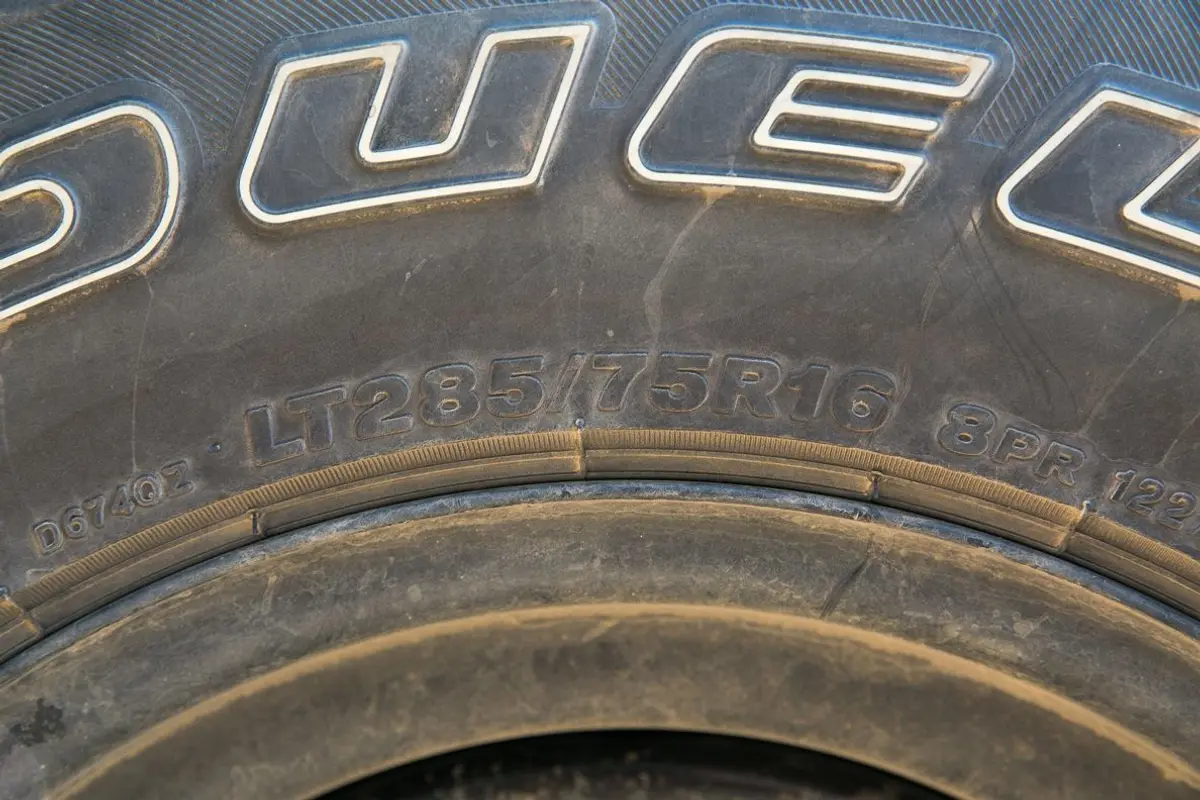
Most tyres use metric sizing these days. As an example, let’s use a ‘285/75R16LT’ as an example, and break it down.
Firstly, the ‘285’ points out the width of the tyre, in millimetres.
After the slash is the height of the tyre’s sidewall or aspect ratio, expressed as a percentage of the tyre’s width (again in millimetres). In our case, the ‘75’ sidewall height works out as 75 per cent of 285mm, which is around 213 millimetres.
The ‘R’ indicates a radial construction (around 99% of tyres these days are radials).
The next number in our example is ‘16’, which indicates the wheel diameter in inches.
Finally, ‘LT’ denotes ‘Light Truck’. Four-wheel drivers want this specification, as it means the tyre has a much sturdier construction than the normal passenger ‘P’ construction. This can sometimes be expressed before the tyre width.
To calculate your tyre size in inches you need to do the following:
We know that we have a sidewall height (from wheel to tread) of 213mm (working out 75 per cent of 285mm width, as above). We need to double that (top and bottom of the wheel) to get 426mm. Then, we convert that to inches, which gives us 16.8, and then add that 16.8-inches to the wheel diameter (16-inch wheel), which gives us an old size of 32.8-inches.
If your tyre’s size is expressed in the old money, it will look something like this: 33×11.50R16 LT. In this sequence, the first two numbers indicate the tyre’s height and width, expressed in inches. This is followed by a letter, which indicated the tyre’s construction (in this case, radial). After that, it’s the diameter of the rim (also in inches), and then the Light Truck designation.
Service Description
Newnes 9370
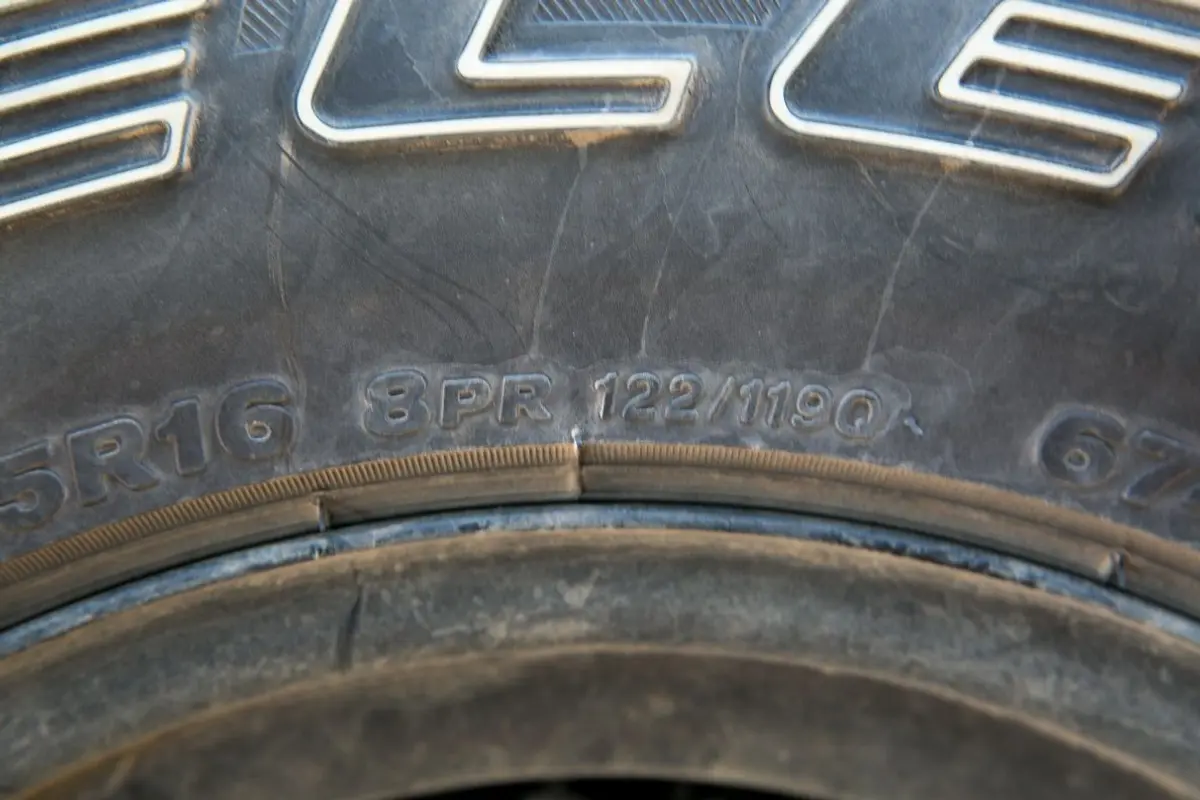
This is also important information, describing what sort of work the tyre is rated for. As four-wheel drivers we need to care about the load index, which is expressed as a number. For our example on the Bridgestone Dueler M/T, its 122 – which is 1,500 kilograms. If there is another figure separated by a slash, that’s the load index if the tyre is used in a dual situation (running them side by side on a rear axle – think big F-trucks). The letter after the load index is the speed rating. Ours is ‘Q’, which gives us 160km/h. Plenty for anything we plan on doing… Probably not going to take our four-wheel drives to the race track!
SPEED RATINGS
Speed Symbol Maximum speed (km/h)
- N 140
- P 150
- Q 160
- R 170
- S 180
- T 190
- U 200
- H 210
- V 240
- Z Over 240
- W 270
- Y 300
LOAD INDEX RATING
108 = 1,000kg109 = 1,030kg110 = 1,060kg111 = 1,090kg112 = 1,120kg113 = 1,150kg114 = 1,180kg115 = 1,215kg116 = 1,250kg117 = 1,285kg118 = 1,320kg119 = 1,360kg120 = 1,400kg121 = 1,450kg122 = 1,500kg123 = 1,550kg124 = 1,600kg125 = 1,650kg
Construction
Newnes 9372
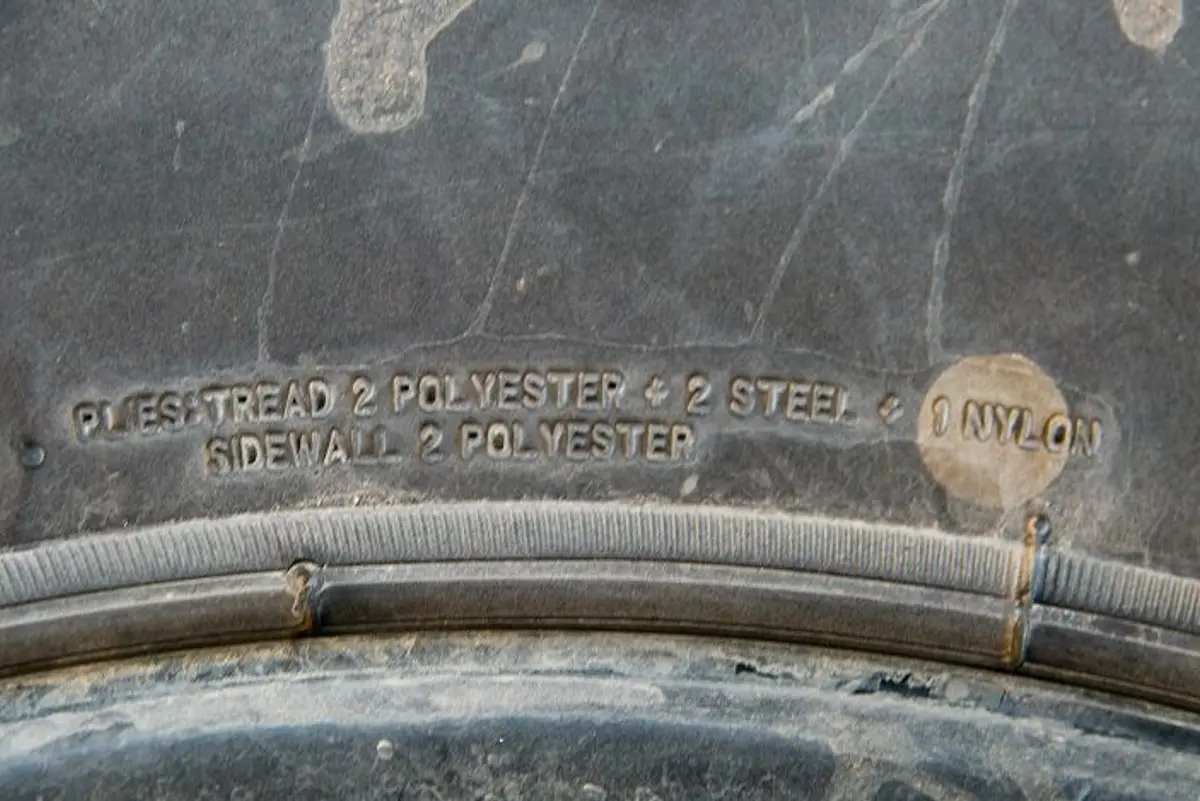
There’s usually some good information to be had here, spelt out as plain as day. You can see how many plies are in the tread and the sidewall, and what they are made of. There might also be a ply rating, expressed as a number (usually 8 or 6) followed by ‘PR’. Whilst this rating does not have as much significance for a radial tyre as for of one of bias construction, it’s still something worth noting.
DOT label
DOT stands for Department of Transport, something required on tyres to be sold in the USA. Most of these numbers relate to manufacture locations and batches – but the last four digits are important: They tell you how old the tyre is. The last four digits of the ‘DOT’ serial number are important to you, indicating the week and year of production. For example, a tyre made in the first week of October 2014 would be 3714. Keep in mind, a tyre that is older than six years should be replaced; particularly on a well-used 4X4. You might also see an ‘E4’ code on the side of a tyre, which means it has met European minimum standards.
Anything else?
That’s not all the information, mind you. There is plenty of other data according to the tyre type, where it was made and what it was made for. Asymmetrical tyres will have arrows that indicate correct rotation, for example. You may also find the specific model number of the tyre; in our case, this was a Bridgestone Dueler M/T D674. So if the manufacturer of the tyre makes a couple of different mud-terrains for example, you’ll know exactly which mud-terrain it is.