

Keeping you trailer or caravan within the weight limits specified by the manufacturer is a real challenge, not only because of the limited weight you can add, but also because of the ways it can be calculated and the myriad of figures that you will see on your compliance plate.
This article will be the first in a series where we will cover weight, with the intent being to help you understand the differences in terms, and what it means for you.
Why is this important? Because it could have implications for your safety, finances, or even legal ramifications if you get it wrong, and authorities are starting to crack down.
Today, I want to run through the basics that you can expect to see on a compliance plate, as well as some considerations. Lets take our Tvan as a example. See the image below of the compliance plate.
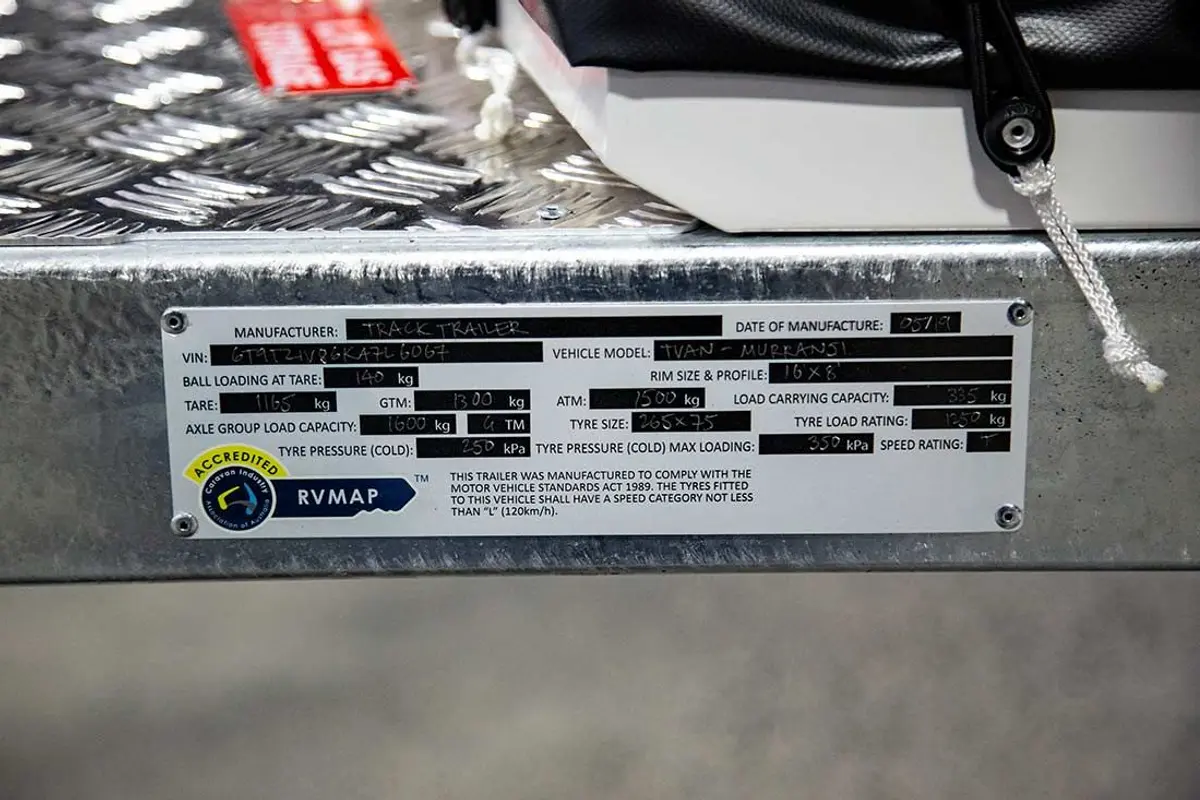
As far as weight is concerned, there are four key pieces of information here:
- Towball downweight – 140kG
- This is the towball downweight when unloaded.
- Tare weight – Weight without fluids (I.E. water, gas) or any non essential items added – 1165KG
- Gross Trailer Mass (GTM) – The maximum permitted weight placed down through the axles onto the road at any time – 1300KG
- Aggregate Trailer Mass – The maximum weight of the trailer, plus the towball download on the trailer combined – 1500KG
So, with the above information, it seems simple right? The maximum weight the trailer can have on its axles is 1300KG, but when coupled to a vehicle, it can weigh a maximum of 1500KG, including the towball downweight. And that means the trailer can handle a towball downweight of 200KG.
Interesting Fact: The Tvan can be upgraded to a GTM of 1600KG by changing the suspension and adding reinforcement to the chassis
But the Axle rating is higher?
There is a line on the compliance plate that states the axle group load capacity, and throws in the number of 1600KG, and then says GTM straight after it.
This had me confused – does this mean that the trailer can actually take a load of 1600KG at GTM?
I reached out to Track Trailer to get a clear answer, and once it was explained to me, it makes sense. The line about axle capacity simply tells you what load the axle is rated to take, and the GTM component tells you that it was rated for a 1600KG GTM as opposed to a 1600KG ATM.
However, this doesn’t mean the trailer or van is approved to that weight. In our case, the original GTM of 1300KG is the maximum weight the trailer can take, and this is set by the manufacturer. So the advice here is ignore the axle load rating – the GTM stamped on the trailer is it.
Is Tare really tare though?
This is a point of contention. The tare weight specified is based on the original manufacturer, and doesn’t take into account any changes the dealer or previous owner made. That means that you may not be able to rely on it to be accurate.
It therefore also means that the payload figure may be wrong, because it is based on the ATM minus the tare weight, and it assumes a certain towball downweight.
This also means that how you pack your van or trailer has implications on the weight distribution that could also affect these numbers.
The point I’m trying to make
When it comes to your van or trailer, you not only have to pack smart, but you need to understand the limitations of your vehicle, based on the compliance plate. You also need to question what you are adding and how to ensure you balance the load, avoid exceeding GTM, and stay within ATM. And this assumes that your tare weights are accurate which may not be the case if it has been modified since original manufacture.
As a case in point, we are going to have the Tvan and Raptor weighed and share the results with you next week. We’ll share costs, considerations and the things we learn from the weigh to help ensure that you too can learn from our experience.