Preparing for off-road touring to experience the breathtaking scenery of the wild Australian bush or more remote spots of the vast Outback is something entirely different from packing for your average annual family holiday. 4WD touring requires some serious planning and preparation to make sure you experience the adventure of a lifetime safely.
Whether your plan is to explore the Old Telegraph Track up in the tropical northern reaches of Australia or to witness the stunning arid (or given all the recent rain, beautiful wildflower covered) landscape of the Simpson Desert, there are a number of things you must do before setting off on your adventure.
But, before you even begin to start packing the camping gear, you first need to check that your vehicle is 100% off-road ready. This goes for well seasoned touring enthusiasts as well as first-timers.
Here at Club 4X4, we have seen our fair share of the unfortunate results poor vehicle checks have had on unsuspecting travellers. The terrain on a track can be unpredictable and the landscape, although beautiful, can be cruel and unforgiving to your rig’s mechanics. So to avoid damage, breakdowns and accidents while out in the bush, the safety of your vehicle comes first.
In this article, we are going to give you 6 essential vehicle safety checks you should do before hitting the road to help reduce your risk of breakdown or accident while out touring.
Use this checklist to carry out the checks yourself if you feel comfortable or enlist the services of a qualified professional to help you get safe before heading out.
Let’s get started!
✔ The Engine
It goes without saying that your 4X4’s engine must be in top condition before you set off touring anywhere. Doing a thorough sweep of your engine’s main functions and parts can save you a whole heap of hassle if anything goes wrong in the middle of the outback somewhere.
The main engine checks you or a qualified professional should carry out are:
- Where are you at in your service interval? A lot of these newer vehicles have incredibly long service intervals – if you’re getting close to the end and you have a long trip, you may want to consider getting it done before you go
- If the above isn’t an issue, check your fluid levels, this includes diff and gearbox levels if you feel confident enough to do so
- Check your cooling system – coolant level and appropriate additives is just as important as checking hoses and hose clamps to ensure they are in appropriate condition. If you have any doubt or are going on a very remote trip, get them all changed and take the current hoses and clamps as spares for roadside repairs.
- Check all your drive belts – if there is any sign of wear get them replaced and keep the current ones as spares
- Heard or felt any niggling little things that you’ve ignored lately? Clutch slipping a little?, a sneaky misfire or a little too much cranking before the engine fires? Now’s your time to get it sorted – especially if you’re planning a very remote trip!
- If you have a newer car, get the scangauge out and check for any errors – and take it with you!
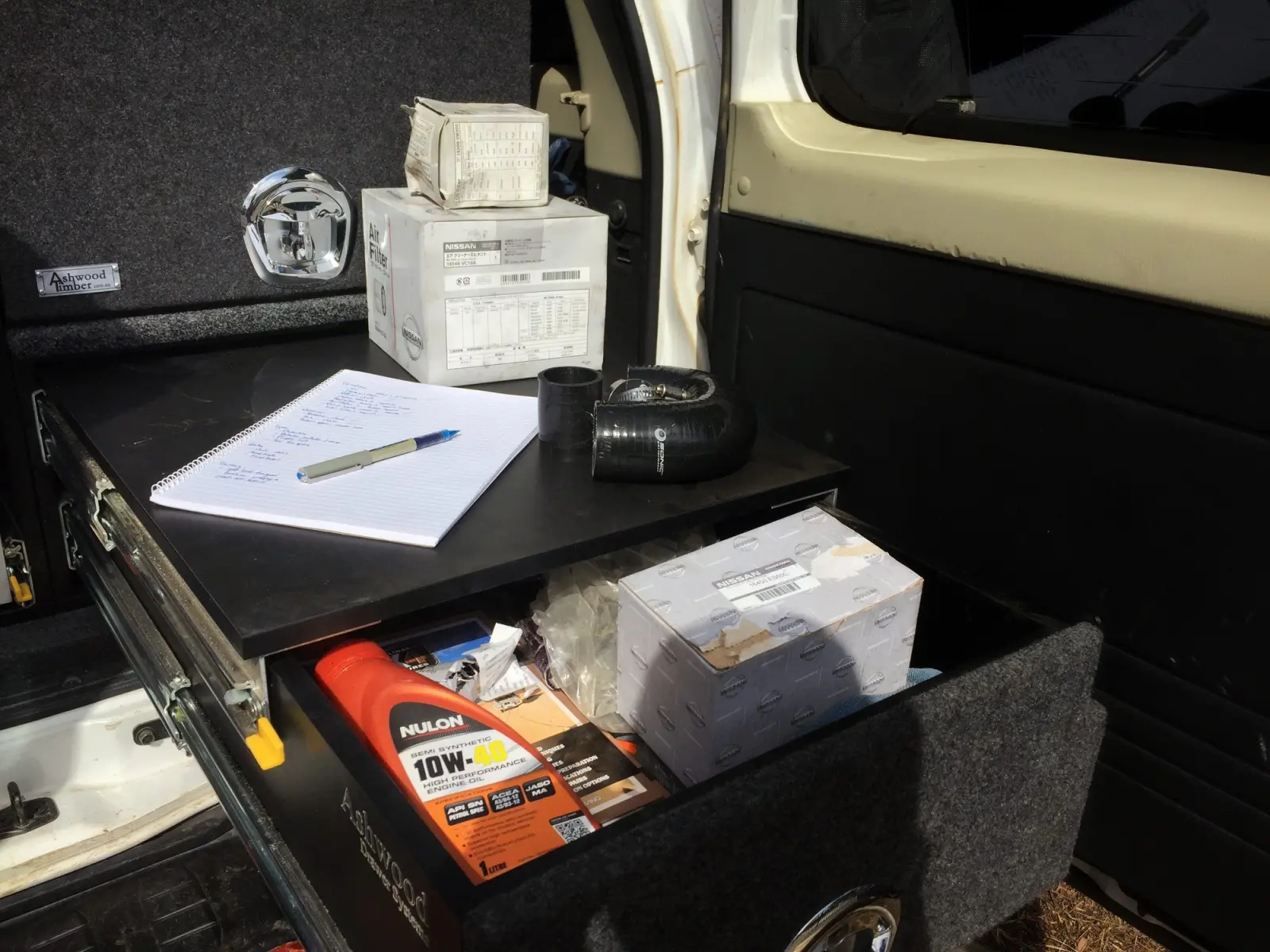
It’s important to carry some spares – a set of hoses including heater hoses, all your drive belts, some oil and oil filter along with a fuel and air filter are a basic minimum for remote travel.
✔ Electrical System
Our GM got caught out recently with an auxiliary battery that was not holding charge. He assumed it was a maintenance free unit “I haven’t checked water in batteries on any of my toys for ages” is what he said. No excuse for this irresponsibility (sorry Kal!) – check the water levels (and ensure you use demineralised water) and if you have a voltage gauge you should know if it’s holding charge – along with your cranking battery. Make sure any auxiliary gear is doing its job including any solar regulators or controllers you’ve installed. A quick check with a voltmeter will also confirm that your alternator is charging sufficiently.
Check your solar gear, are your panels working?, are your connections clean and in good condition? Plastic plugs do deteriorate over time particularly if exposed.
Make sure you take a set of the fuses used throughout your setup and some spare connectors. Electrical tape works a treat for various issues or some heat shrink if you prefer, along with some crimpers, side cutters and strippers. A small box can hold all of this gear.
✔ Brakes
The most important safety system on your vehicle is one you should always pay attention to, not just before trips. We are driving around with heavy loads so the braking systems on our rigs take a beating.
Vibrations on the steering wheel when the brakes are applied can often be traced to warped brake discs, so make sure you get them the attention required. Nowadays brake discs can be machined on a vehicle which we feel gives a better result – make sure you replace your pads at the same time.
Inspection of components may reveal glazing from heavy heat cycles – have a think about how you use your brakes as this may either point to overuse or a need for upgrading.
Finally check your fluid, is it at the right level? Over time brake fluid absorbs oxygen and moisture which limits its effectiveness. If you’ve not replaced your fluid for a while get it done.
✔ Suspension
Check all suspension components for play or noises, and lubricate everything that should be lubricated. Tie rod ends, ball joints, drag links and shackle bushes should have no free play. If they do, replace or get them replaced before the trip.
Inspect all your bushes – these often cop a lot of abuse with the various components under your vehicle getting stretched and flexed over the various terrain off-road – these are like the rubber (or nolathane) bands that keep everything together.
Not technically a suspension component, but wheel bearings are an important one, both for your vehicle and the trailer you may be towing. Usually a pretty hardy bit of kit, when these let go they can lead to all manner of issues. If you don’t know how to do it, get them checked – a failure at 110km/h can be disastrous.
✔ Identify Fluid Leaks
Your 4X4 should have absolutely no fluid leaks of any kind. Even the smallest signs of leakage and seeping of any fluid anywhere should be investigated and repaired.
Any competent professional can perform these tests, and they are sometimes free. Even if you think it’s regular sweating of fluids rather than a leak, do not leave on your trip before the cause of the fluid loss has been found and corrected, because the last thing you want is to be stranded in the middle of nowhere without a way to fix the leak.
✔ The Tyres
One of the larger tyre manufacturers had a line in an ad that said something along the lines of “your family is protected by 4 pieces of rubber contacting the road no bigger than your hand”. Tyres are a very important part of our hobby.
It goes without saying that the bare minimum is a set of quality all-terrain rubber if you don’t have a set already. Some prefer to go to a more aggressive tread like a mud tyre. It all depends on the type of driving you prefer and where you are planning to go.
Once you’ve decided, make sure you take care of your rubber. Regular rotations and balancing is a good idea. The carcass of an off-road tyre is much heavier than a light duty car tyre – so they can scallop if not maintained. Always check for blisters, cuts and tears especially in your sidewalls and adjust your pressures to suit the conditions.
There is no excuse for being unprepared for your trip. Given that your 4×4 is your ticket, you must take the time to ensure you’ve prepared it for where you plan to go. If you’re not mechanically minded that’s fine, any reputable mechanic or better yet, 4X4 store will do a full inspection for what we think is a small cost.
If you breakdown remote, you are stuck with the cost of getting out. Remembering that your roadside assistance provider won’t go anywhere that isn’t sealed (yep – read the documents). If you’re lucky enough to be insured with Club 4X4 – you may have some or all of the costs of an off-road recovery reimbursed to you.
Hopefully this checklist is going to give you a good start on getting prepared for your next 4X4 adventure.
Happy touring guys!