You don’t truly appreciate how thirsty your rig is until you hitch up a trailer, at which point, the fuel gauge drops quicker than I down a beer on a day ending in Y. I've had trips where it felt like I was burning fuel just by breathing near the accelerator. I'll never forget the time I had a brand-new Y62 Patrol on test. I took it out to Birdsville towing a trailer loaded with gear; I'd never witnessed fuel economy disappear in such a spectacular fashion before.
Towing will always burn more fuel, that’s just part of the deal. It’s as unavoidable as flies in the Outback or your mate giving you grief for choosing the wrong 4WD, but there are ways to stretch your fuel a bit further, and no, they don’t all involve driving like you’re trying not to wake a baby in the back seat. This isn’t about miracle additives or internet wizardry, it’s hard-earned, real-world advice from someone who’s emptied enough tanks to know what actually works.
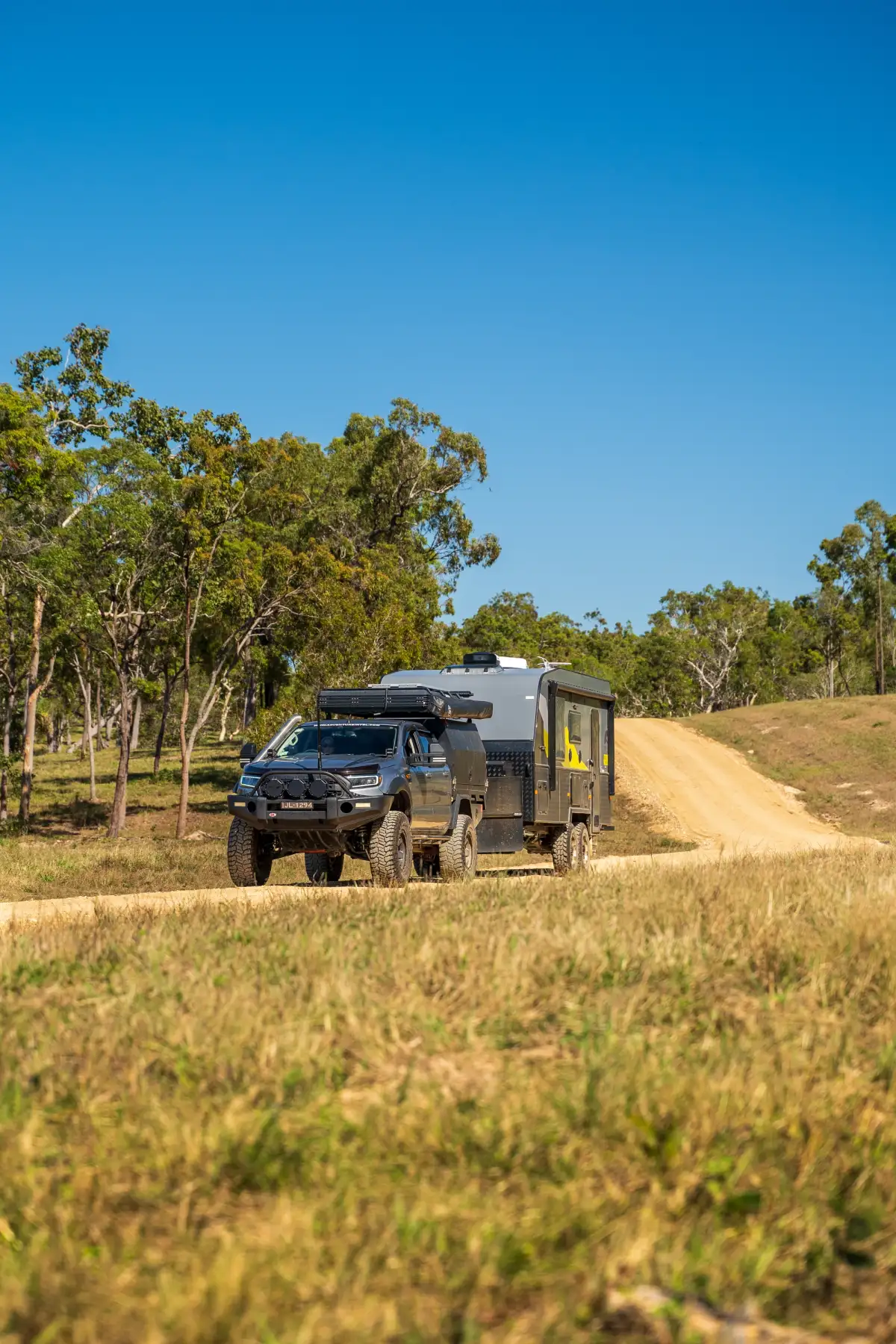
4x4 towing caravan through the bush
AERODYNAMICS MATTER
I fully appreciate the irony of talking about aerodynamics in a world where most caravans have the wind resistance of a wheelie bin strapped to a shipping container, but the truth is, even if you’re towing something shaped like a brick, the way you set up your rig can still make a massive difference.
Wind drag is real, and thanks to physics, we know it increases exponentially with speed. The faster you drive, the harder your engine has to work to push that big flat thing through the air. Throw in a few extras, roof racks, recovery boards, awnings, and a couple of “just in case” jerry cans and you’re effectively towing a parachute with a diesel bill attached to it.
So, if you're chasing better economy, tidy up the airflow:
- Avoid stacking gear high unless it’s absolutely necessary
- Keep the front of your van as clean and flat as possible. Toolboxes, collapsible fire pits, jerry can holders and whatever else you’ve bolted on all create more turbulence than you think
Keep it Smooth
If you want to save fuel while towing, start with how you drive. Throttle control, gear selection, and anticipation, that’s where the real gains are.
I call it creamy driving. No harsh inputs, no sudden pokes of the throttle, no last-second braking. Just smooth, consistent control that keeps everything flowing. It's not about driving slow, it’s about being deliberate. Carry momentum through the terrain, roll up to stops and traffic lights where possible and drive with purpose.
On flatter ground, cruise control can help. But on rolling or uneven roads, it’ll often do more harm than good, dropping gears and spiking revs every time the road so much as twitches. In those conditions, you’re better off managing the throttle manually and keeping the engine in its sweet spot.
This kind of driving won’t just save you fuel, it’ll also help keep your transmission cool and reduce stress on your tow rig and van. Creamy driving. Learn it. Use it. It works.
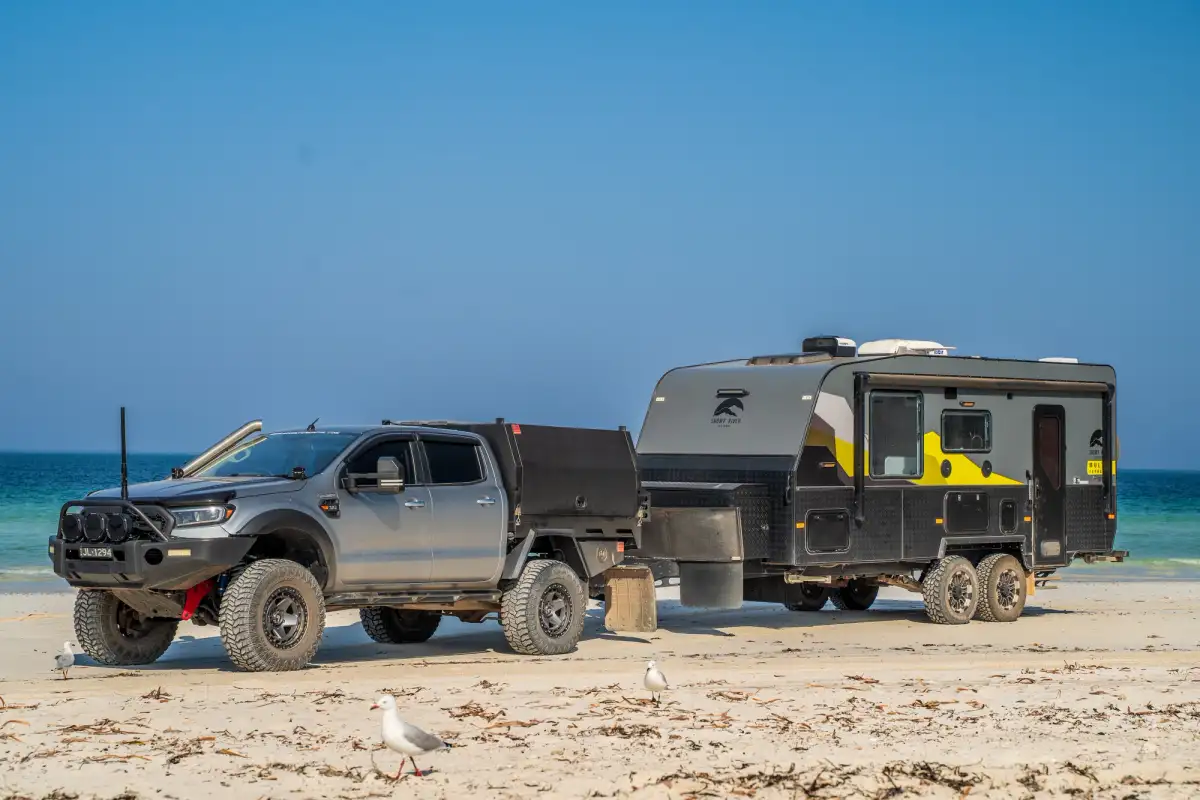
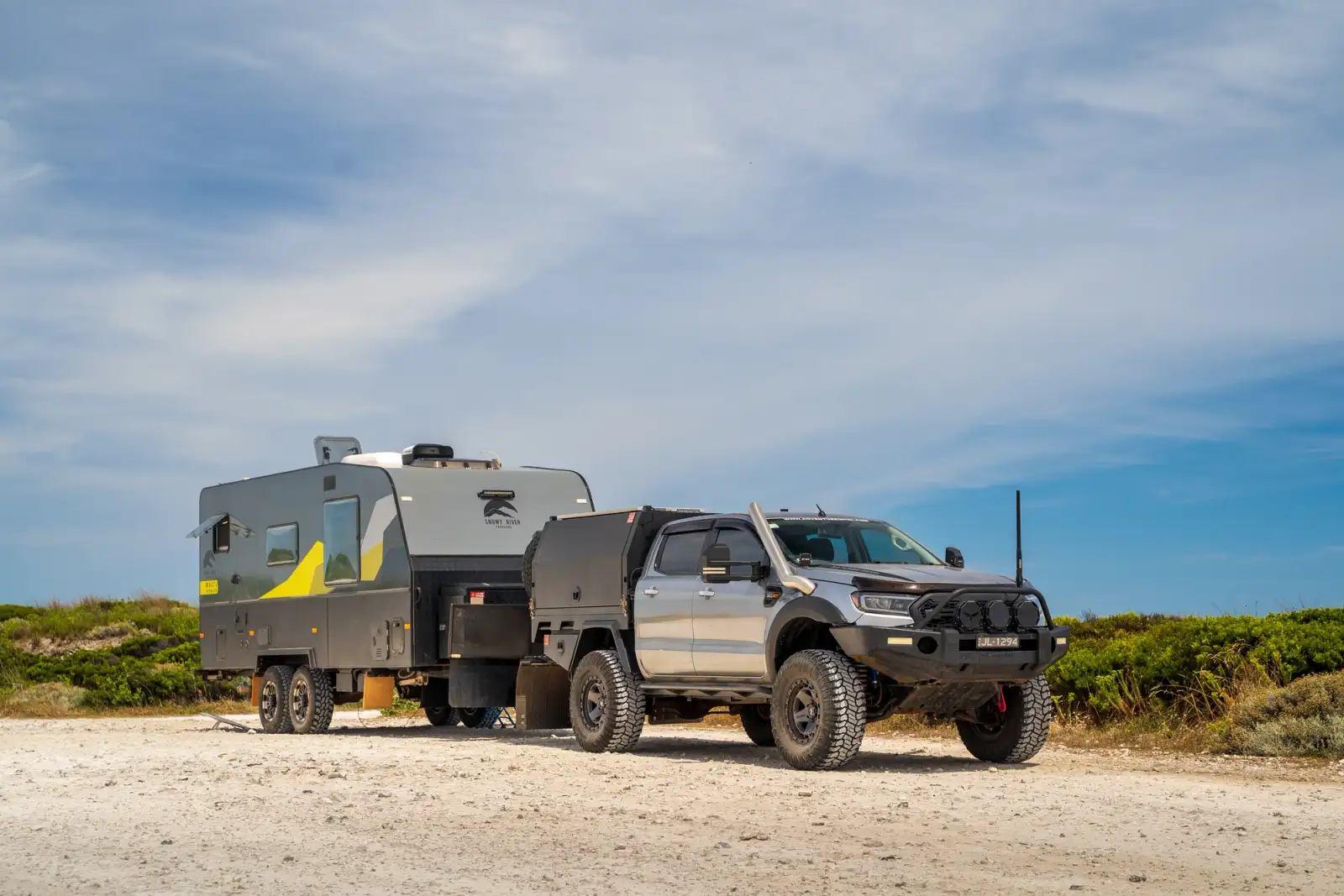
4x4 towing caravan on beach
KNOW YOUR GEARS
Modern autos are generally pretty clever, but they’re not perfect. Towing throws all sorts of curveballs at your transmission, especially when the gearbox can’t decide what gear it wants and starts hunting up and down like it’s chasing its tail.
If you’ve got manual shift control, use it. Don’t leave it all up to the torque converter. My advice here is that you want to hold gears, not surf them. Most diesels are at their most efficient somewhere between 1,800 and 2,200rpm, and staying in that zone as much as possible is key to better fuel use and a less stressed engine.
A lot of people make the mistake of letting the gearbox “figure it out", especially when they hit hills or open road sections. But that constant shifting, especially under load, just burns more fuel and builds more heat. Better to lock it in, keep the revs steady, and let the torque do its thing.
If your rig’s got a tow/haul mode, use it. It’s not a gimmick. It changes shift points and helps control things like downhill engine braking. That means less work for your brakes and a happier gearbox over long distances.
Pro Tip: Wondering what gear to use going downhill while towing? A good rule of thumb: use the same gear you needed to get up the hill. If it took 2nd gear to climb it, that’s the gear you want to descend in. That keeps engine braking working in your favour, saves your brakes from doing all the heavy lifting, and keeps the whole setup steadier and safer.
Autos will often try to upshift unless you tell them otherwise, so don’t be afraid to knock it into manual mode and take control. Your brake pads will thank you at the bottom.
TYRES, PRESSURES & ROLLING RESISTANCE
Here’s where a lot of people lose easy fuel economy without even realising: tyre pressures.
Underinflated tyres = more flex, more heat, more rolling resistance, and yep, more fuel burned. This applies to both your tow rig and your caravan. Most folks are religious about checking the tug, then completely forget the van. I’ve seen fully loaded dual-axle setups dragging themselves up the Stuart Highway with tyres 20 PSI below where they should be and wondering why they’re getting 23L/100km and everything smells like cooked rubber.
Check your pressures cold, with a good gauge, not something that’s been dropped fifty-seven times since last Tuesday and left in the rain, like a servo one. For most towing setups, you’ll want to start somewhere around 50PSI, depending on your load, tyre size, and type.
It’s also worth noting that tyre choice affects fuel economy. Bigger tyres, heavier construction, and more aggressive tread patterns all increase rolling resistance. Larger rolling diameters can throw out gearing too, which means the engine has to work harder, and that shows up at the bowser.
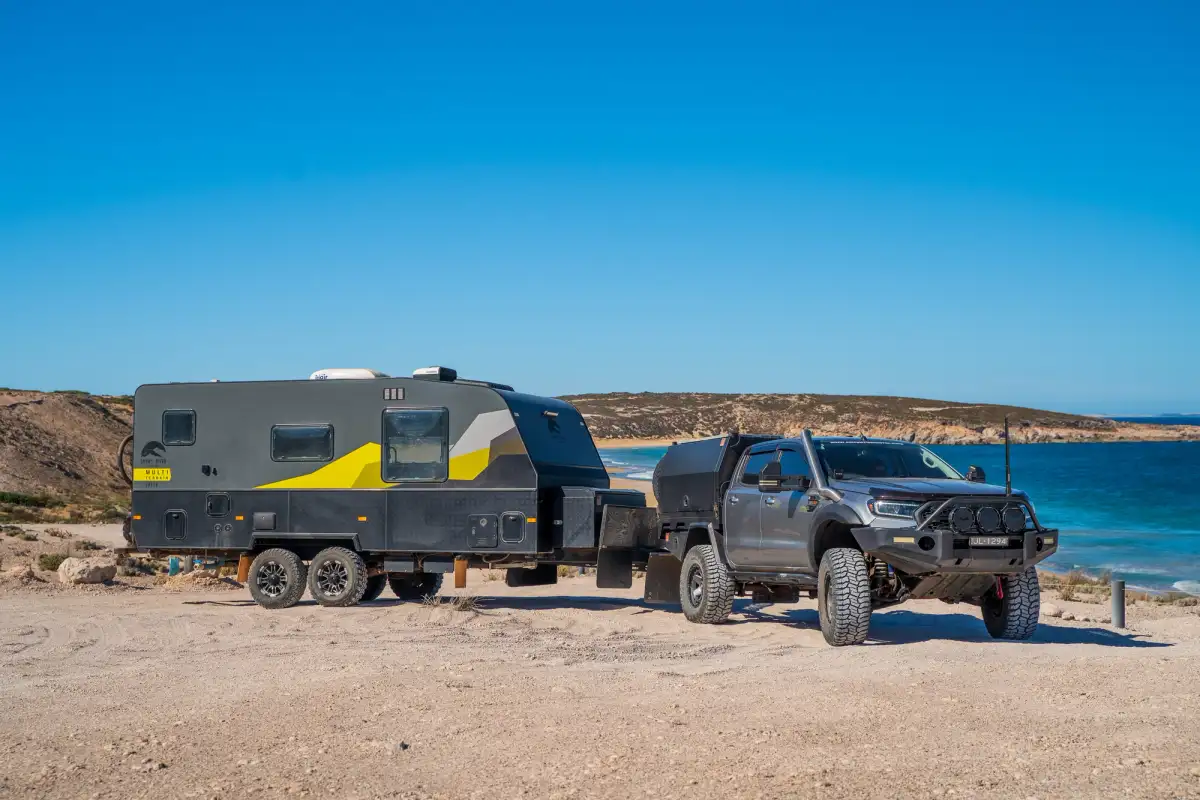
4x4 towing caravan on a sandy cliff with beach in background
WEIGHT IS THE ENEMY
It doesn’t matter how good your engine is, the more weight you’re hauling, the more fuel you’ll burn. That’s not opinion, that’s fact, and out on the road, it adds up fast.
Water, tools, spare parts, recovery gear, it all adds up quicker than you think. I’ve been guilty of overpacking too, and don’t get me started on the juicer my wonderful missus insisted on bringing and never once used. But if there’s one thing I’ve learned, it’s this: every extra kilo costs you range. Especially when you’re towing uphill into a headwind, which, for some reason, always shows up right when you don’t need it to.
Ask yourself:
- Do I really need full water tanks if I’m heading to a powered site?
- What tools do I really need and which ones are dual purpose?
- Am I carrying weight “just because” or because it’s actually needed?
I once pulled over 190Kgs, out of my setup, removing the roof top tent, an unused generator, extra fuel I never touched, and a drawer full of miscellaneous things I realised I didn’t really need. The result? Noticeable improvement in fuel use and better drivability too.
Less weight means less load on your engine, less strain on your brakes and suspension, and less money disappearing through the fuel filler.
Pack smart, not heavy.
KEEP YOUR RIG IN FIGHTING SHAPE
If your engine’s not running right, your fuel economy’s going to cop it, towing or not.
Dirty air filter? Old injectors? Chocked up EGR? It all adds up to your engine working harder than it needs to and when you’re hauling a few tonnes behind you, those small issues get magnified.
I’ve seen people chase economy with fancy gadgets while ignoring the basics. This is the stuff that seriously matters:
- Clean air filter = better combustion and better economy
- Fresh oil reduces friction
- A blocked EGR limits combustion efficiency and can lead to higher fuel consumption, especially in modern diesels
- Dodgy wheel bearings or dragging brakes add rolling resistance
- Believe it or not, even poor wheel alignment can hurt your fuel economy. When your tyres are scrubbing the road instead of rolling clean, your engine’s working harder just to keep you moving
Routine maintenance is crucial for maintaining your tow rig and its economy.
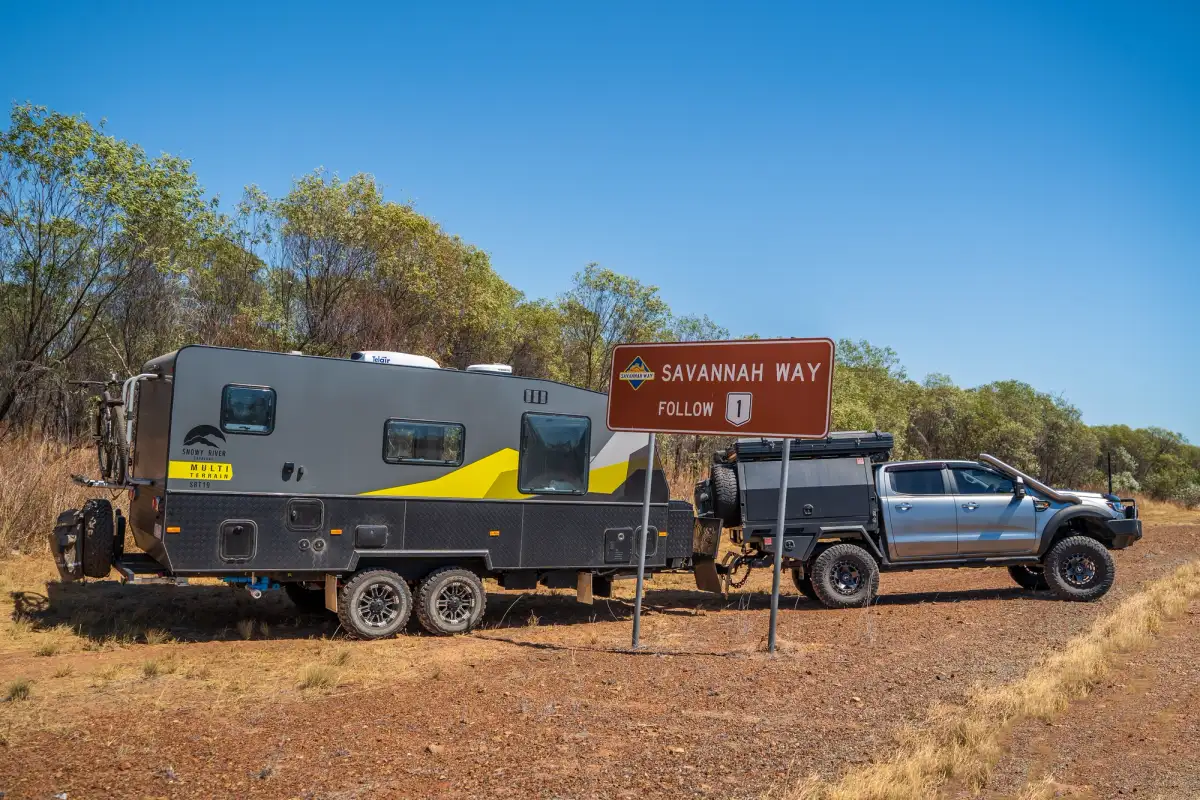
4x4 towing caravan posing next to sign of savannah way
OTHER STUFF THAT HELPS:
- Engine tunes: A proper remap or quality power module can improve efficiency, especially if it optimises torque curves under load. Just make sure you speak to a tuner who understands what you’re doing with the vehicle and remaps it accordingly.
- Additives: Some diesel additives help with lubricity and injector cleaning, don’t expect miracles, but they genuinely can help over time. For as long as I can remember I’ve run Moreys Fuel Stabiliser.
- Servicing: Clean filters, correct oil, and no warning lights = better fuel economy. A dirty MAF sensor or clogged up fuel filter will burn through fuel less efficiently whether you notice it or not.
- TPMS: A tyre pressure monitoring system pays for itself the moment you catch a slow leak before it kills your range and your rubber.
THE LONG AND THE SHORT OF IT:
You’re never going to get Prius-level efficiency towing a three-tonne van into a headwind, but you can absolutely stop throwing away diesel by the litre.
It’s rarely just one thing. It’s the lot: how you drive, what you pack, how you load it, and whether you’ve bothered to check your tyre pressures since last Easter. I’ve tested it all. I’ve done the same track in the same rig and averaged 17L/100km one week and 22 the next, the difference? Better habits, less junk.
Want to know the good news? None of this is hard. It just takes a bit of thought, and a lot less “that’ll do” attitude.
Hitched and holiday-ready?
Anywhere you can legally go in Australia, we'll be in tow.