Running out of fuel in remote Australia is rarely caused by bad luck.
Most of the time, it’s caused by optimism. Optimistic fuel consumption figures. Optimistic distances. Optimistic assumptions that the next roadhouse will definitely be open. Optimistic thinking that “she’ll be right”.
Fuel planning for remote travel doesn’t need to be complicated, but it does need to be conservative. It’s about understanding your real-world consumption, knowing how far you can comfortably travel, allowing a buffer, and choosing fuel-carrying solutions that are simple and easy to live with.
This article looks at the practical side of planning fuel stops for remote area travel, from understanding your consumption, to carrying extra fuel, to researching stops, and understanding the nuances of remote area fuel-ups.
Know Your Real World Consumption
Once you add barwork, tyres, storage, camping gear, water, fuel, possibly a trailer, and then throw in soft sand, low-range work, corrugations and slower average speeds, fuel consumption changes dramatically.
The easiest way to understand your real-world consumption is simple: track it.
Fill the tank. Reset the trip meter. Drive normally. Refill. Divide kilometres travelled by litres used. Do this over a few tanks and you’ll start to see a realistic average.
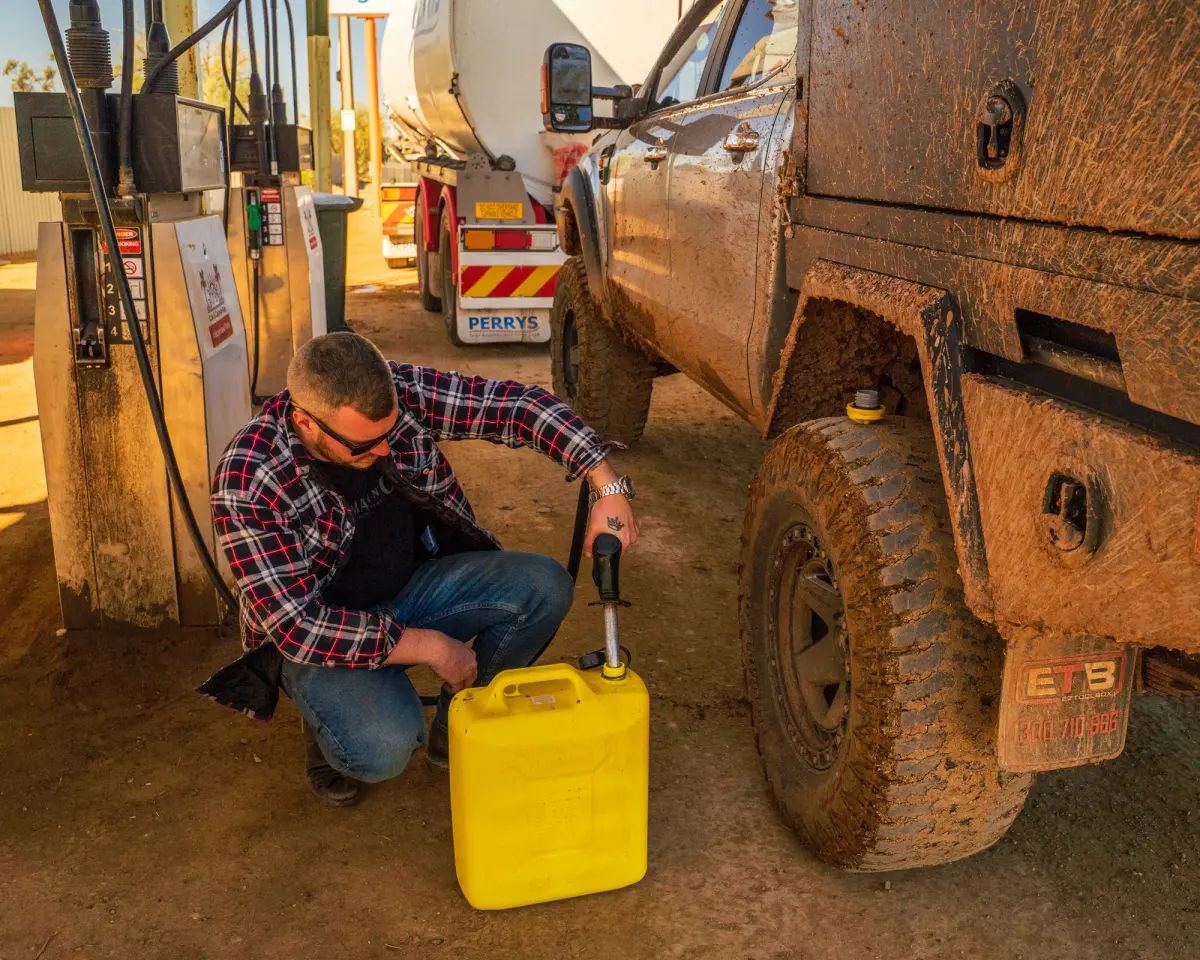
Josh from Adventure Intel Australia filling up a jerry can at a service station in the Outback
If your vehicle normally averages 12L/100 km around town, don’t be surprised if it’s 15–18L/100 km loaded and touring.
If you tow, add more again.
A lot of people are doing fuel calcs based on their best numbers. It’s often safer to be planning off your worst-case number. That doesn’t mean assuming disaster. It just means using a conservative figure that reflects heavy, slow, remote driving.
Once you have a realistic number, you can start making sensible decisions about range, carrying extra fuel, and how far apart your fuel stops can safely be.
What Blows Fuel Consumption Out
Fuel consumption is influenced by a bunch of different factors, and most of them trend in the wrong direction once you leave the blacktop. Vehicle weight plays a big role. Barwork, storage systems, water, extra fuel, camping gear and accessories all add mass, and moving mass requires energy.
Speed matters too. Sitting on highway speeds with a loaded vehicle will use noticeably more fuel than backing it off slightly and cruising. Terrain is where things really start to change. Soft sand, corrugations, low-range work and slow technical driving all increase fuel usage significantly. Beach driving in particular can use dramatically more fuel than sealed roads.
Towing compounds everything. Add a boat or caravan and your baseline consumption rises straight away.
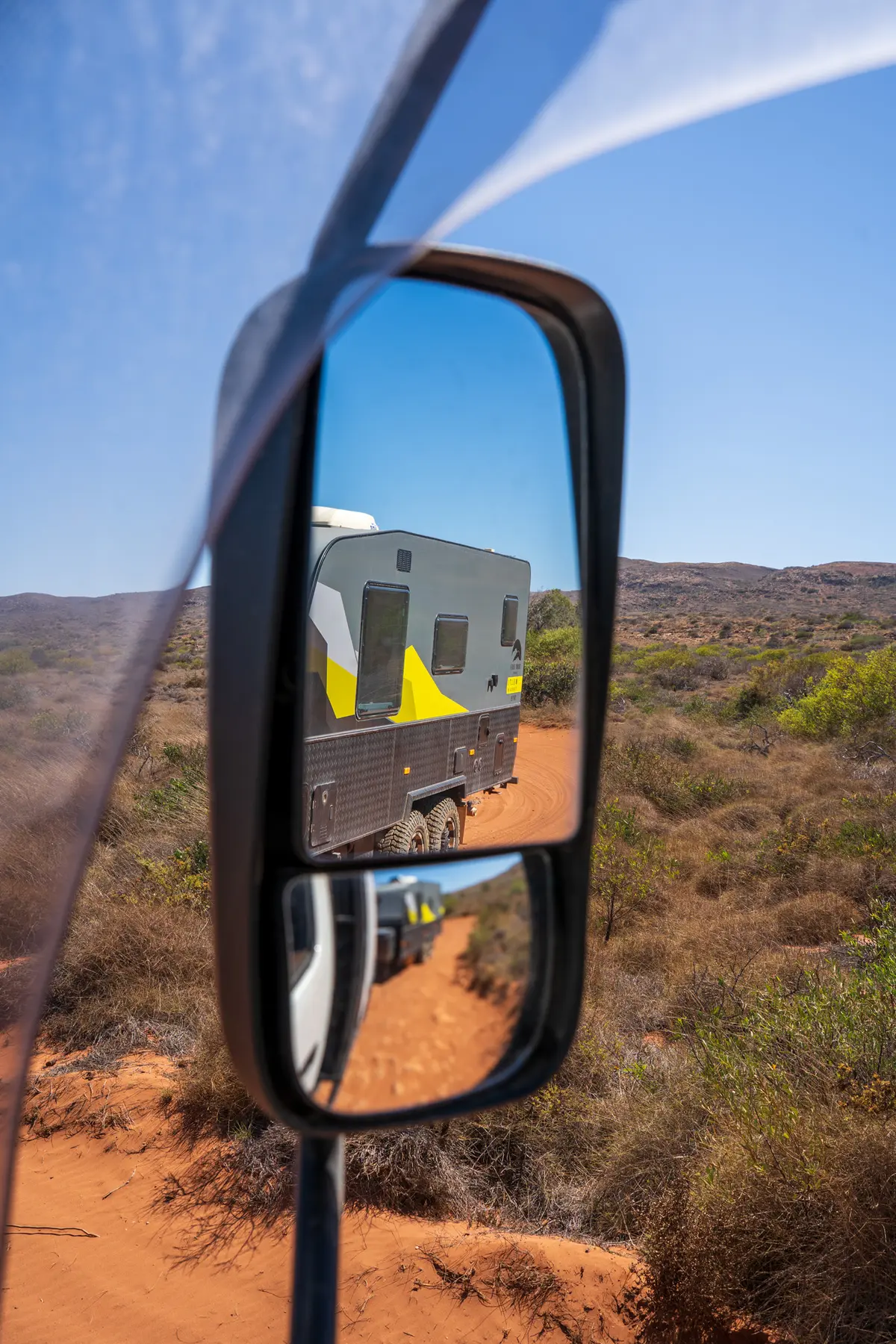
A caravan pictured from a rear view mirror out a Ford Ranger 4X4
Vehicle health also has a direct impact. Something as simple as a faulty temperature, MAF or oxygen sensor can push a vehicle into running rich without throwing an obvious fault code. The result is higher fuel consumption and reduced range.
The wind has a profound effect. A strong headwind with a loaded touring vehicle is effectively like driving uphill for hours at a time. That’s why remote-area fuel planning should always be based on conservative numbers rather than best-case figures.
Building a Safe Fuel Range and Buffer
Once you’ve got a realistic idea of what your vehicle uses in the real world, the next step is working out a comfortable operating range.
Say your vehicle averages around 16L/100 km when it’s loaded and touring, and you’ve got 140 litres of usable fuel onboard. On paper, that suggests a maximum range somewhere around the mid-800 kilometre mark.
That doesn’t mean you should be planning 800-kilometre gaps between fuel stops.
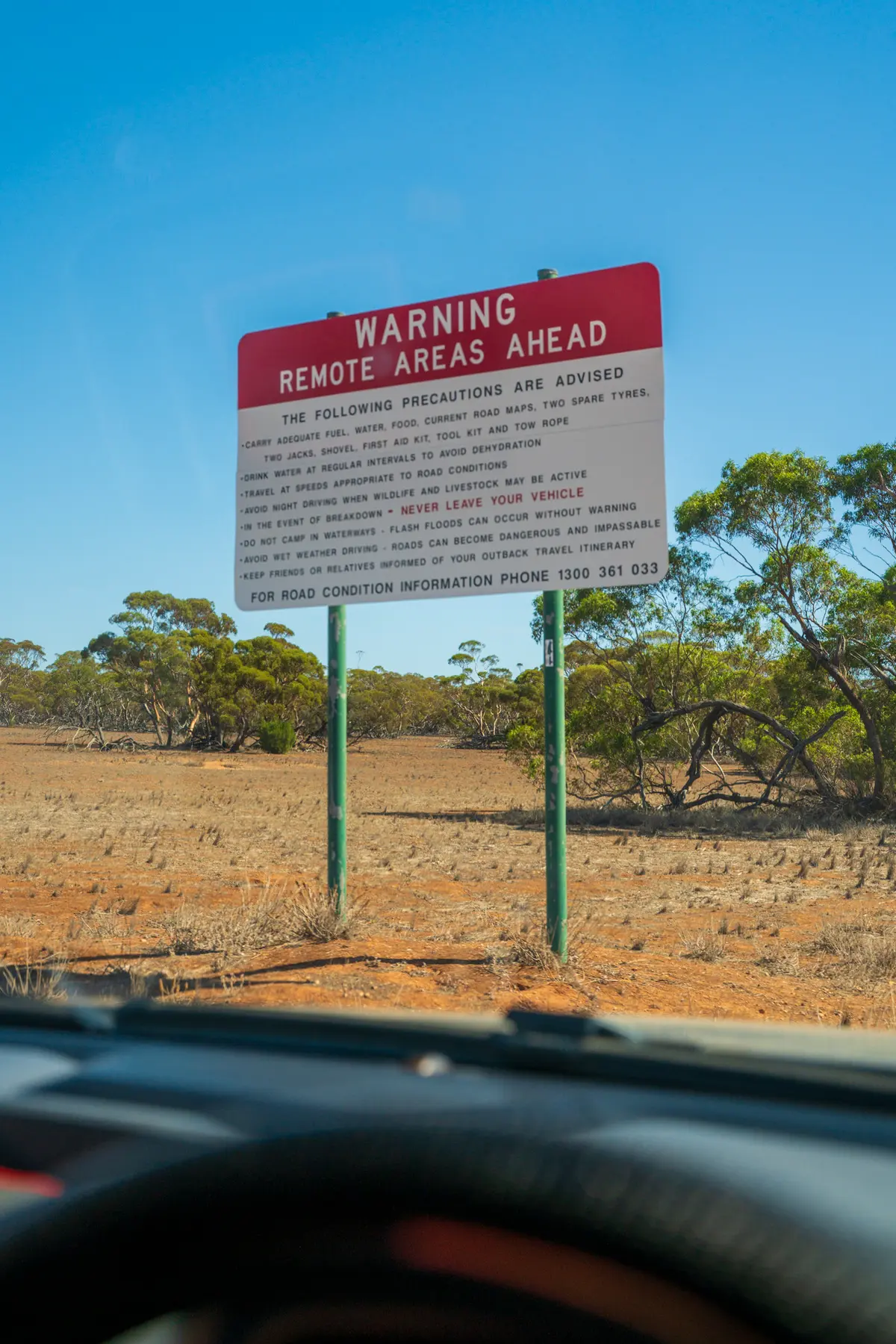
A road sign in remote Outback Australia with a warning
A far more sensible approach is to treat only around 75 to 80 percent of that theoretical range as usable. In that same example, you’d be planning on roughly 600 to 650 kilometres between fuel opportunities.
That buffer is what absorbs the realities of remote travel. Detours, softer-than-expected conditions, headwinds, low-range slogs, missed turns, closed tracks, or simply burning more fuel than usual for a day or two. More importantly, it gives you options.
If a roadhouse is unexpectedly closed, out of fuel, or you decide to change plans, you’re not instantly in survival mode.
The aim with fuel planning isn’t to arrive on vapours. It’s to arrive with fuel still in the tank.
Researching Fuel Stops and Roadhouse Realities
With your working fuel range and buffer sorted, the next step is working out where fuel is actually available along your intended route.
This doesn’t mean locking yourself into a rigid day-by-day plan, but it does mean having a general awareness of distances between fuel points and which towns or roadhouses you’re likely to pass through.
There’s a bunch of different fuel and GPS apps for this, most areas do a great job of sign posting fuel stops and distances. If you’re carrying Hema’s paper maps, roadhouse operating hours and phone numbers will be listed.
You may get caught out if you assume every fuel stop operates like a suburban servo. Remote roadhouses live in a very different world.
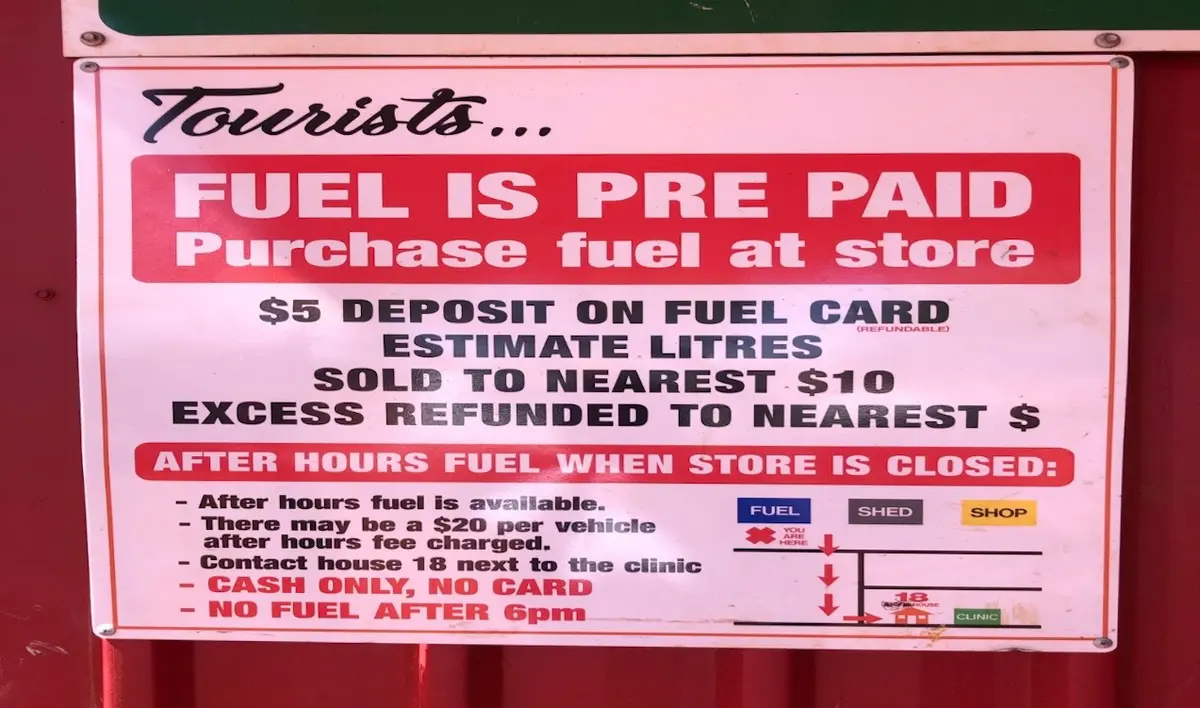
A sign at a rural service station in Australia
Some have limited opening hours. Some close earlier than you’d expect. Some offer after-hours fuel, but it may involve a call-out fee. Some rely on satellite internet, which means EFTPOS can go down. Some are cash only. Some have no mobile reception at all.
That doesn’t make them unreliable by any stretch. It just means you need to be prepared.
Carrying some physical cash is still a smart move in remote Australia. So is making sure your bank account has enough funds in it without needing to log in and complete a transfer.
It’s also worth checking whether a location offers after-hours fuel and what their process is. Turning up late and discovering fuel is available but you can’t access it is a frustrating way to learn.
Carrying Extra Fuel: LONG RANGE TANKS VS JERRY CANS
Once you leave the highways behind and start kicking up dust carrying extra fuel starts to become part of the equation.
There are a few ways to do it, but in my experience long-range tanks are the best way.
Jerry cans absolutely work, and plenty of people use them successfully, but they come with compromises. They take up cargo space that could otherwise be used for storage of water, food or camping gear, they’re heavy when full, they need to be mounted securely, and at some point you still have to manually pour fuel into your main tank, usually when you’re hot, dusty and already over it.
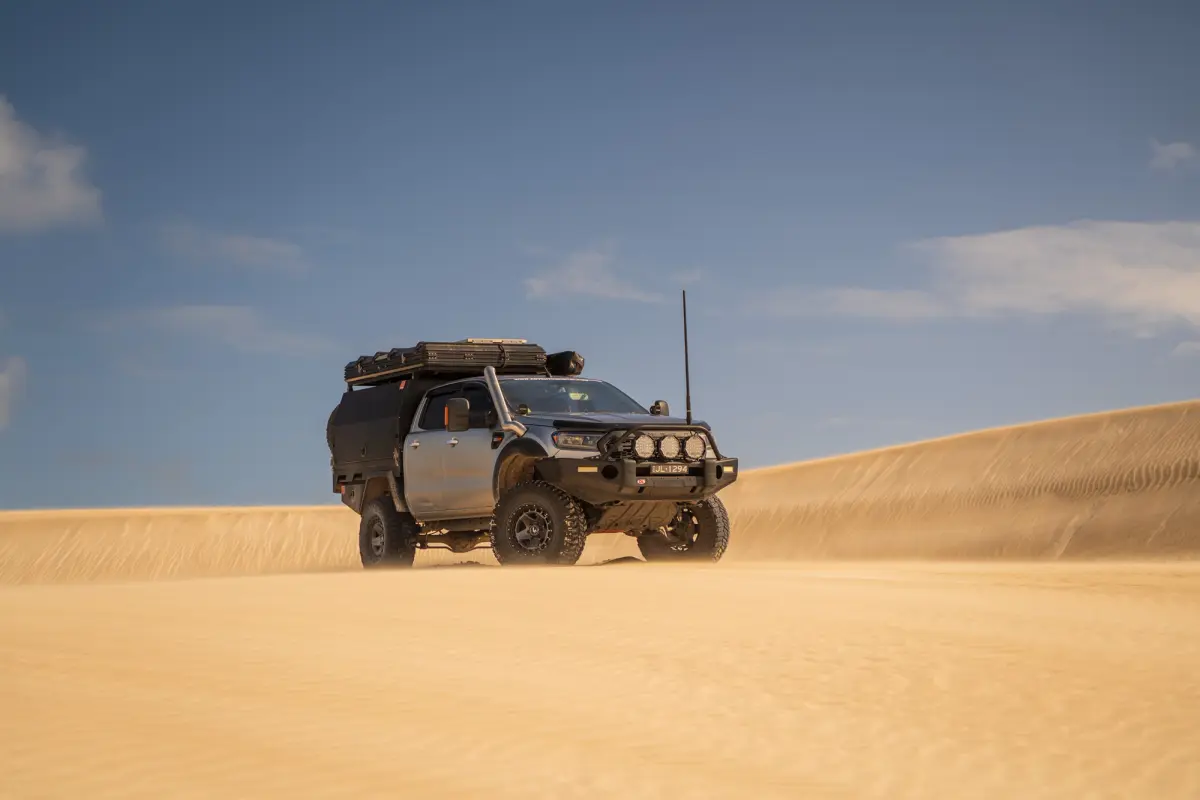
A Ford Ranger on a sand dune in the Australian Outback
Long-range tanks, on the other hand, simply increase the fuel capacity of the vehicle by replacing or supplementing the factory tank.
Most quality long-range tanks are built from thicker material than standard tanks, many include internal baffling or swirl pots to maintain consistent fuel supply, and most have drain plugs, which makes maintenance, misfuelling and water contamination management easier.
They also occupy space that is generally unused, underneath the vehicle, rather than consuming valuable cargo room. From a usability point of view, they’re hard to beat.
You fill once, you drive, and you don’t have to think about decanting fuel, lifting heavy containers, or managing loose cans.
That doesn’t mean everyone needs one.
Jerry cans still make sense as a lower-cost way to extend range, particularly for occasional trips or one-off long legs. They’re also flexible, in that you can choose when to carry them and when to leave them at home.
For frequent remote travel, however, the convenience and practicality of a long-range tank is significant.
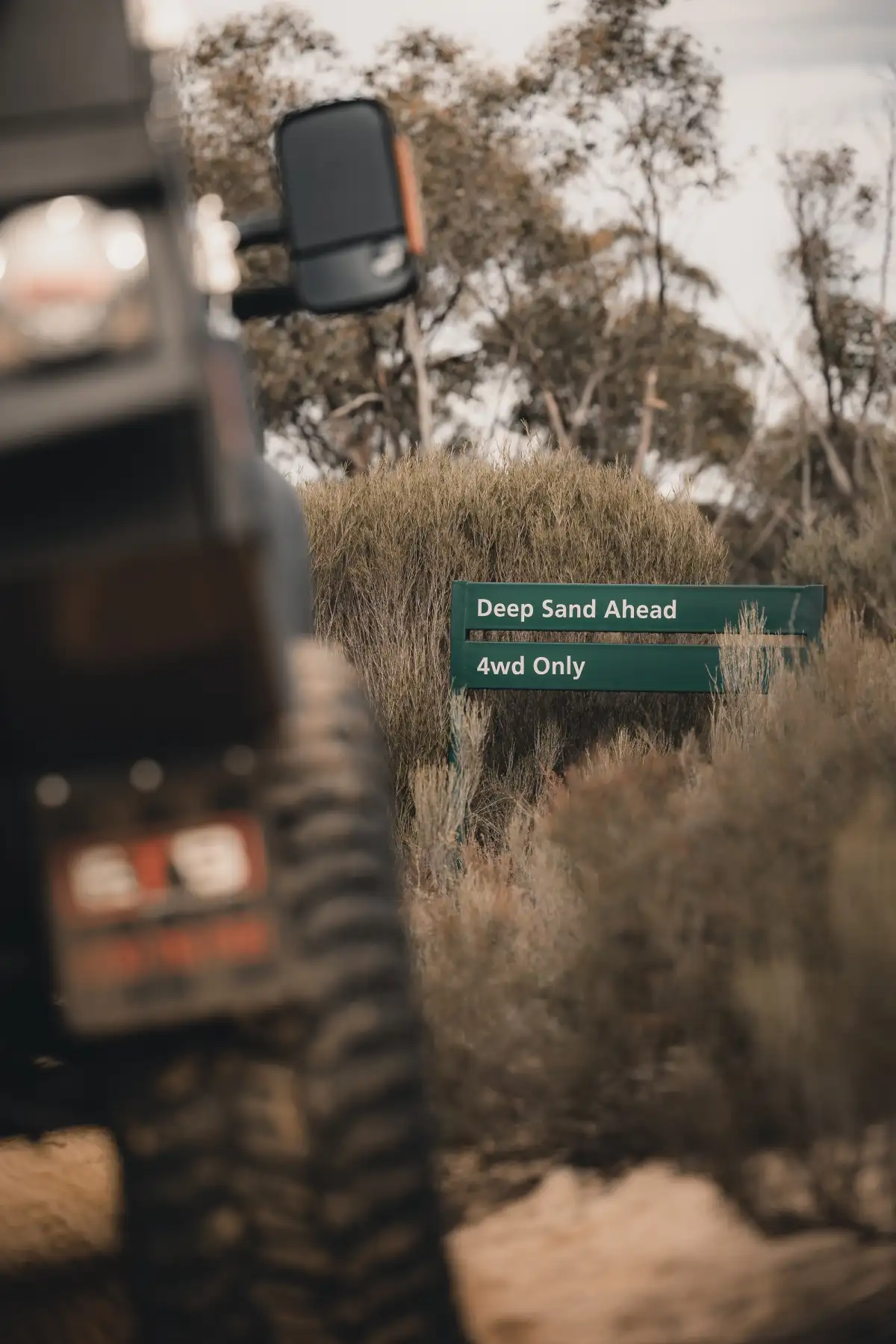
Deep sand ahead 4WD only sign in Australia
The Final Fill
Good fuel planning for remote travel isn’t about perfection or complicated calculations. It’s honestly just about stacking small, sensible decisions in your favour. Know your real-world consumption. Build a comfortable buffer.
Carry extra fuel in a way that’s easy to live with. Have an idea of where fuel is available along your route. And be prepared for the realities of remote Australia. Roadhouses can close. Card systems can go down. Deliveries can be delayed. Weather can shut roads. None of that is unusual.
If your vehicle uses AdBlue, that deserves the same level of planning as fuel. Not every remote joint stocks it, and some only carry limited quantities. None of this is meant to make travel feel restrictive. It’s meant to make it safer and more relaxed.
When fuel planning is done well, it fades into the background. You’re not constantly watching the gauge. You’re not stressing about distances. You’re free to focus on the track, the country, and the experience.
And that’s the whole point of going remote in the first place, isn’t it?
Heading to the Outback?
Cover anywhere you can legally go in Australia