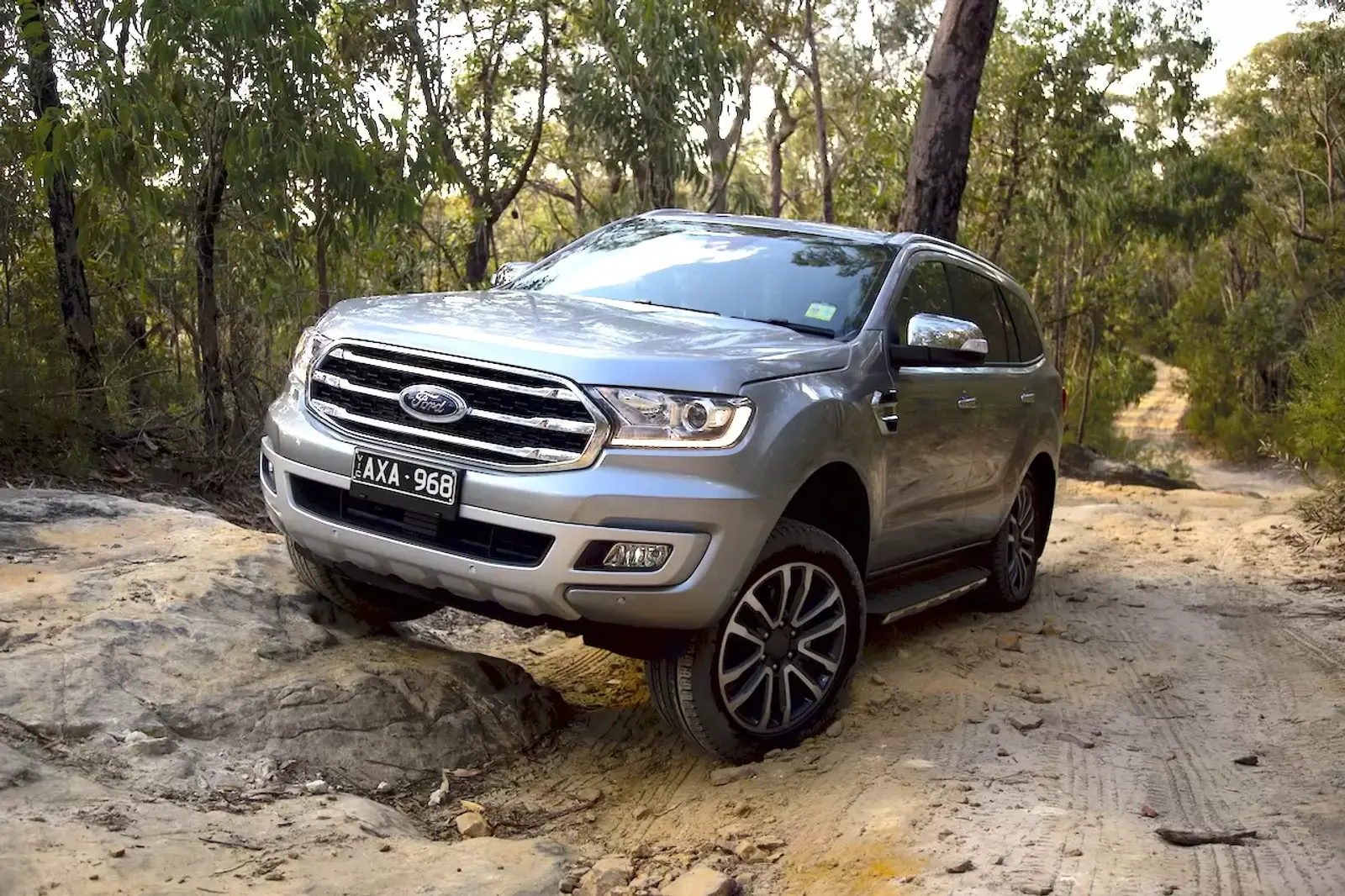
Article from: Unsealed 4X4
We have three months with the Everest Titanium to find out if the bi-turbo engine, the seven-seat layout and its rough-road ability make it a must-buy for families.
What are we testing? The 2019 Ford Everest Titanium
What’s running it? Isaac Bober
Why are we testing it? To find out if the Everest is the best family rough roader wagon.
What it needs to do? While we’ve got the Everest, we want to find out if it can do it all, from the school run to the supermarket shop, to highway runs, towing and off-roading.
6 September 2019: This week, I took the keys to our long-term Ford Everest and used it as a crew car on a comparison test. Indeed, this was the Everest’s first proper trip off the black stuff.
Loaded up with 4×4 recovery gear, a boot full of camera gear and two shooters, the Everest made short work of the drive from the office to our test location, out the back of Lithgow, NSW. The bi-turbo diesel engine and the 10-speed automatic transmission made it easy to keep up with and overtake traffic and the suspension tune, even on 20s offered a plush ride.
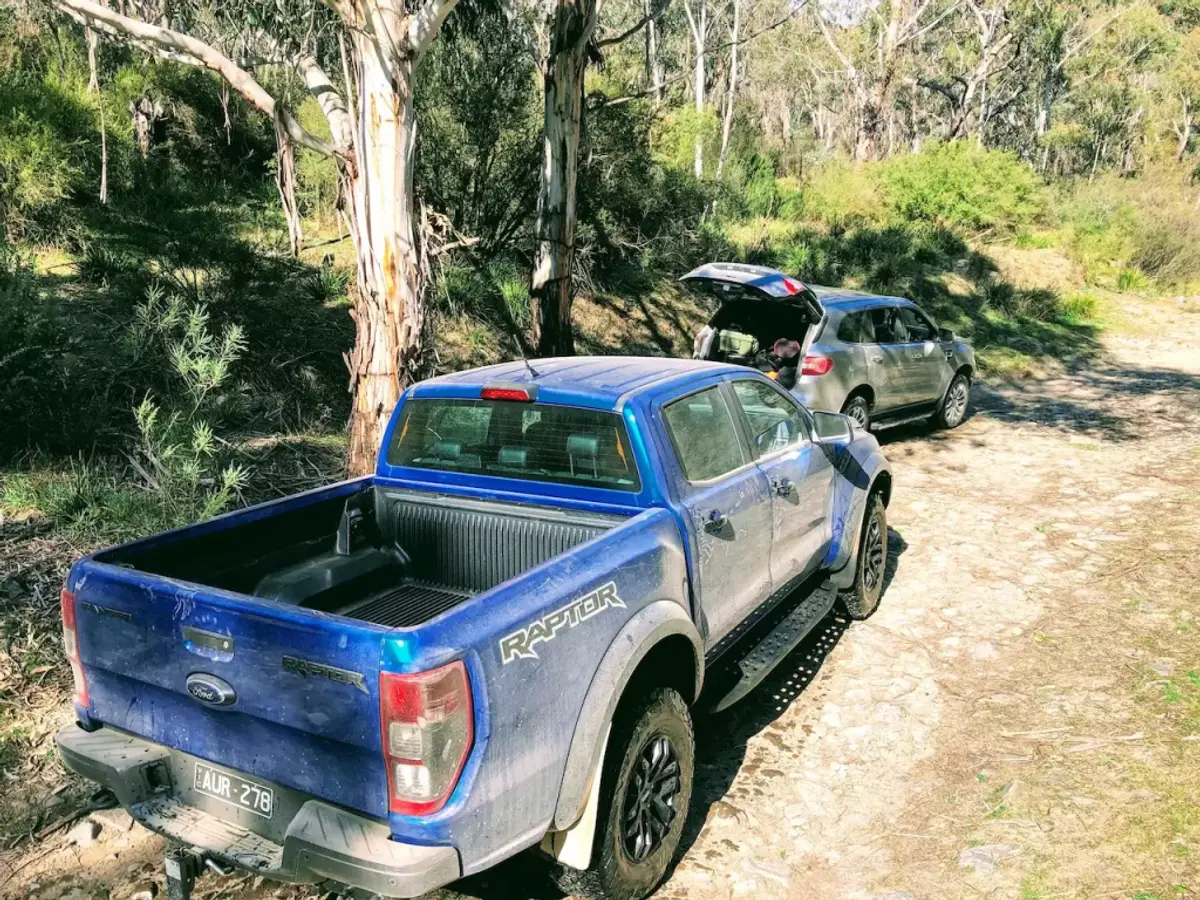
The two cars being compared (one was the Raptor, the other is a secret, for now) were better set up to handle the tracks we were on, one had mud-terrain tyres and the other aggressive all-terrain rubber. But, the Everest on its 20s and road-oriented tyres followed everywhere the other two did with the exception of one technically challenging hillclimb; with better tyres I reckon the Everest would have made it up without too much drama.
We already knew the Everest was good on-road; probably the best in the segment, but I’d never driven one off-road. First thing I noticed was the simplicity of changing into low-range. No longer do you need to put half your body weight through a lever to get it to engage, but instead a simple press of the button and away you go. The engine proved nice and strong when crawling at low speeds thanks to peak torque arriving at 1750rpm, but we noticed the 10-speed auto didn’t seem to enjoy being in low gears in low range when traversing steep tracks. We’ll spend some more time exploring this niggle over the coming weeks. Another observation was that the traction control seemed to allow a little too much wheelspin before grabbing the spinning wheel, but as we’ve noted before, better tyres would have probably fixed this as we probably wouldn’t have lost grip in the first place.
In the end, after driving the Everest across dirt, gravel, rocks, up and down hills, and through rivers, one of the most impressive features was the fact it could do all of that and then provide passenger car-like levels of comfort once back on the highway. And you used to only really be able to say that about a Ranger Rover… – by Josh Needs.
August 30 2019: Our Ford Everest Titanium long-termer arrived only a few days after I did at Unsealed 4×4, but after a couple of weeks’ worth of work commuting, I’ve already put 1000km on the clock. And about the only dirt it’s seen has been a quick run or two along a short and tricky track near the office which is where we grabbed these quick snaps.
The Everest copped a very mild update towards the end of last year getting a new-look bumper and grille but, I’ve got to say, unless you parked them side by side, you’d be hard pressed to spot the differences. The inside copped some similarly minor updates, but it was the addition of the Ranger Raptor’s bi-turbo diesel engine and 10-speed automatic transmission that grabbed headlines. And, while I don’t want to open up that can of worms right now, I can say that, for me, the bi-turbo is more suited to the Everest than the Raptor.
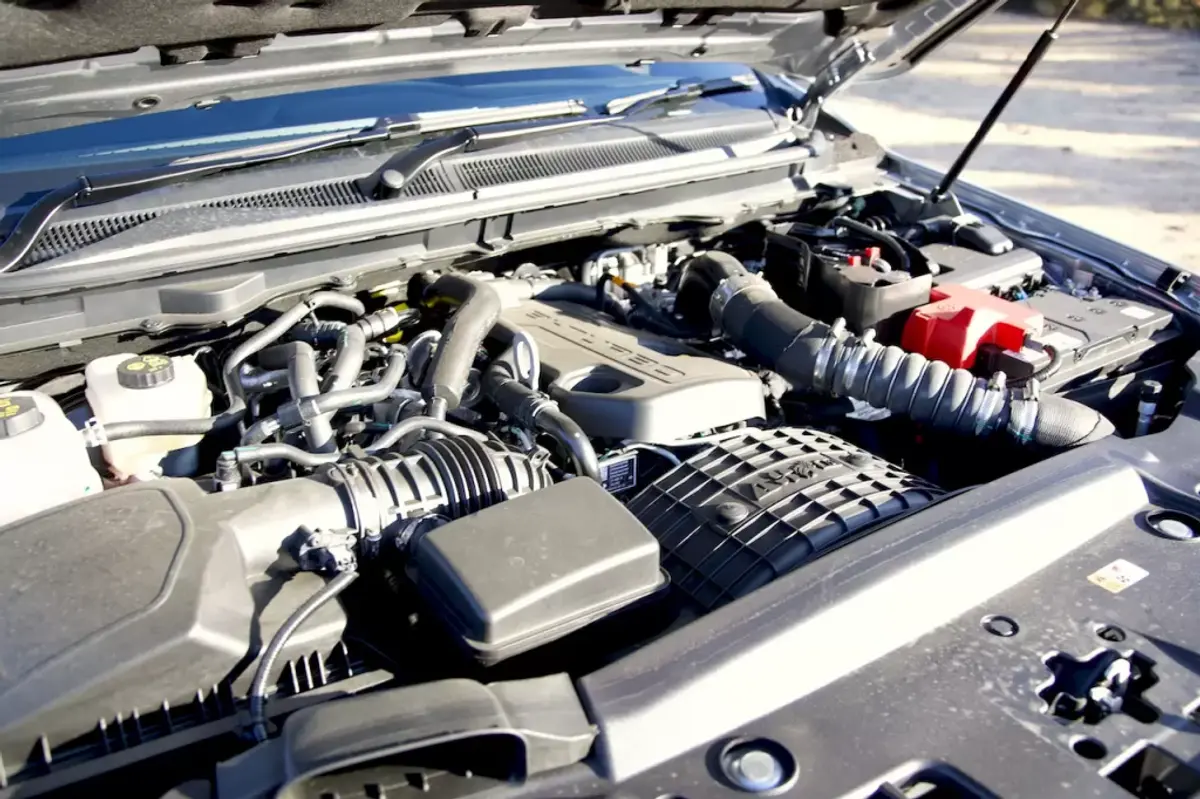
While models like the mid-spec Trend offer access to both the 3.2-litre five-cylinder turbo-diesel and the new 2.0-litre bi-turbo, the Titanium Ford has given us is available exclusively with the bi-turbo motor. Ideally, we would have been long-term testing the Trend because, if you’re looking to buy a touring 4×4 then the Trend is probably the model you’d look hardest at.
The Titanium on the other hand walks a fine line between trying to appeal to those who want to explore and also take bites out of, say, non ute-based 4×4 wagons like Toyota Prado. With the update last year, while other Everest saw a price rise, the Titanium actually copped a price drop of $711, now listing from $73,990+ORCs.
For the coin it gets not-very-off-road-friendly 20-inch alloy wheels, a tow bar (but without brake controller), semi-auto parallel park assist, dual glass panel powered sunroof with power blind, eight-way power front passenger’s seat with manual lumbar adjustment, heated front seats, power fold third-row seats (individually – 50:50), ambient lighting and illuminated stainless steel front scuff plates.
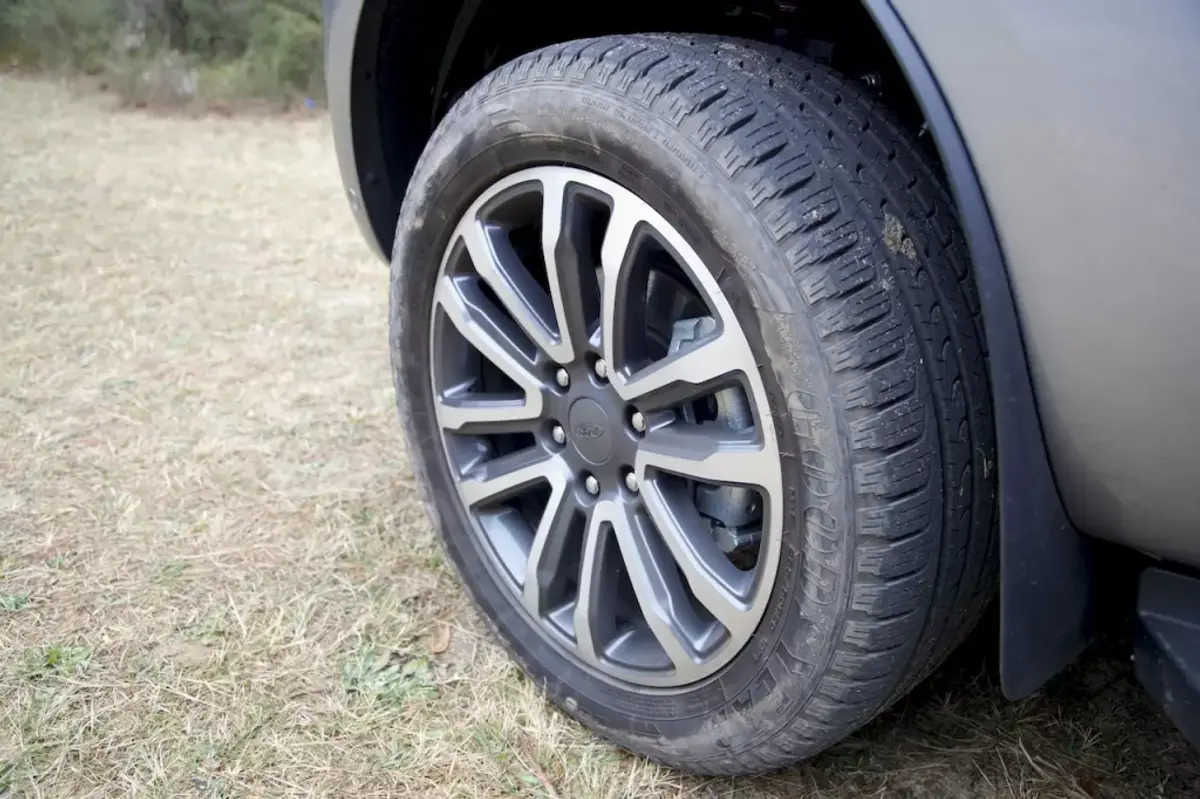
While Ford offers a no-cost 18-inch alloy option for the Titanium our long-termer has arrived, as mentioned, on 20s. This isn’t ideal but given we’re not going to be building this thing up for Outback travel, we should be able to get away with it for most of the things we’ve got planned.
The Everest has always done a really good job of hiding its ute-based origins, in fact, I think you can confidently claim that as far as on- and off-road ride and handling go, it’s the pick of the ute-based 4×4 wagons. And it’s much better than a Prado too. Leave the bitumen and the Prado edges the Everest but it’s not by much and, again, the Everest is probably at the head of the pack as far as the rest of the ute-based wagons are concerned when you head off-road. Sure, there’ll be those who’ll argue something like an MU-X with its proven diesel engine is more of a known quantity, but then it lacks the refinement of the Everest around town which is where you’ll spend 90 percent of your time.
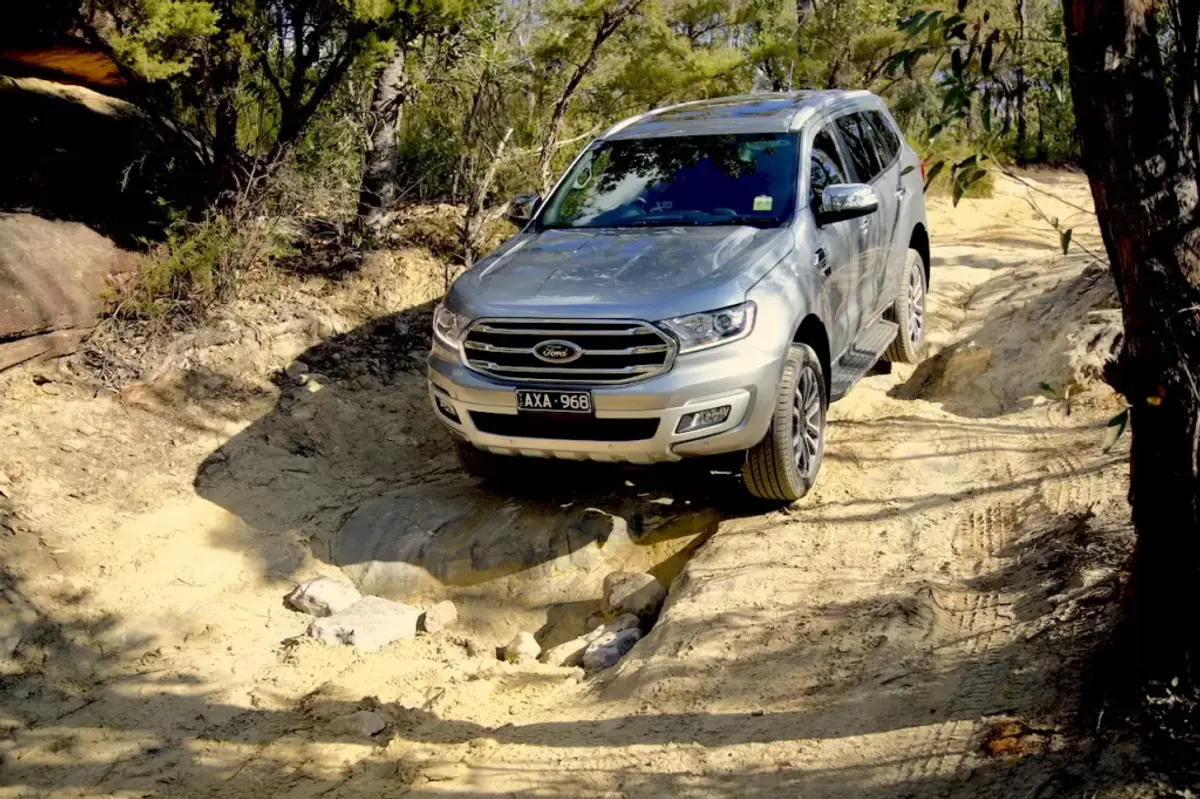
The Everest also offers a clever traction control set-up, as well as an adjustable Terrain Management System which we’ll go into further detail on in another article, and a rear differential lock to ensure there’s not a lot it won’t go up and over. Where the Everest steps ahead of its key competitors is when the rear differential lock is engaged and you run out of wheel travel, the traction control system remains active on the front axle meaning you’ll be able to maintain forward momentum. We’ll show you this in action in a video review in the coming weeks.
But, in short, our quick run out a long a few tracks this week told us a few interesting things about the Everest that we’ll explore in more detail down the track. For instance, the Everest runs out of wheel travel compared with, say, the Toyota Prado, but its traction control system is excellent and so is grip in low-range. The track we drove is only short but there’s a real mixture of terrain, from hard dirt, to soft bush sand, to rocks and ruts and even some mud. The Everest handled it all pretty easily, to be honest, but the highway tyres meant the traction control system was working harder that it would have needed to if we’d had something more aggressive around the 20s. And, going forward, this will be one of the first things we’d like to sort out. The off-road angles are 29.5-degrees approach, 25-degrees departure and 21.5-degrees rampover and the Everest offers an impressive 800mm wading depth, and the front and rear overhangs are 916mm and 1137mm, respectively.
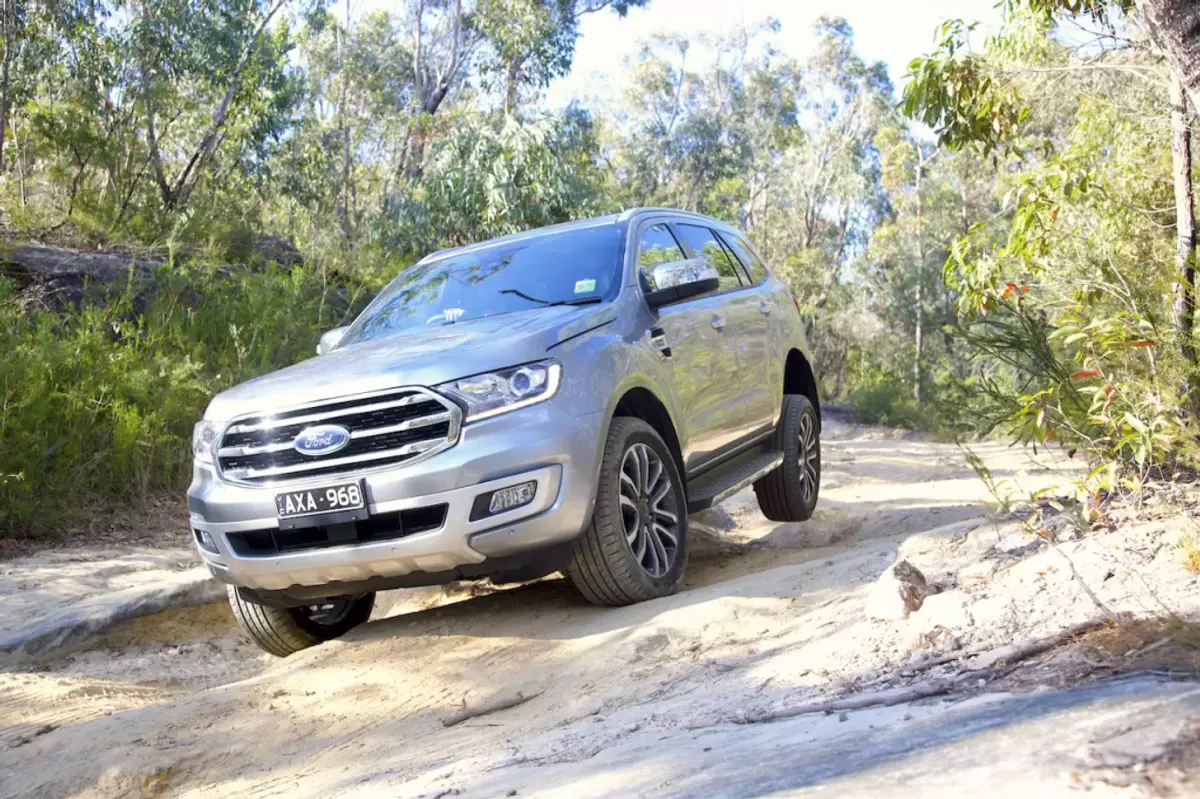
So, what will we be doing with our Everest while we’ve got it? Well, beyond writing regular updates here online and in the magazine, we’ll be fitting some accessories to it to make it a little more rough-road friendly, taking it on some trips, and just generally living with it to find out what the Everest is like to live with on a daily basis. If you’ve got any questions you’d like answered about the Everest then leave a comment below. – Isaac Bober