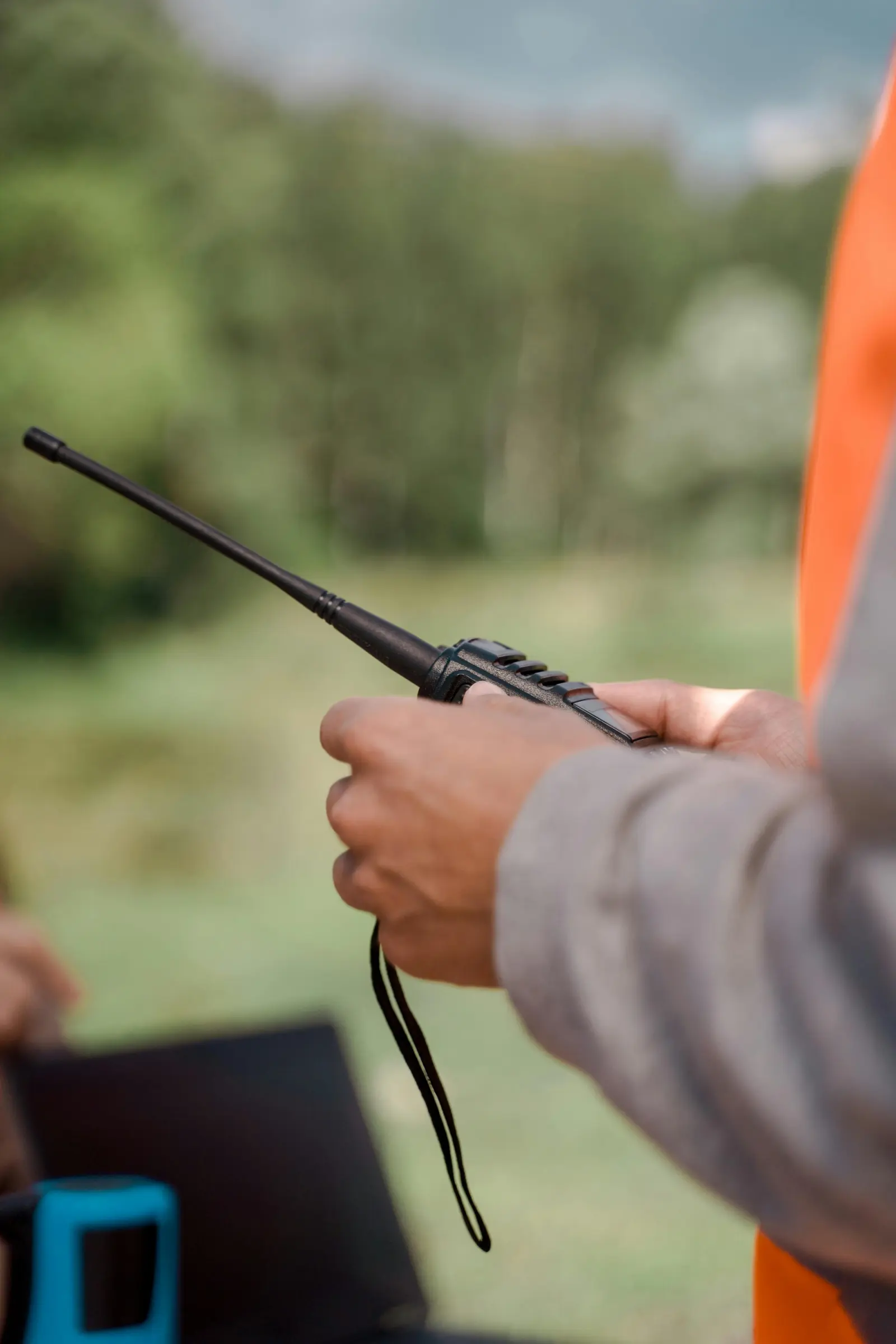
If you looked at a graph of how cool getting a pair of walkie talkies is for Christmas vs how old you are, it would peak as a kid, because there’s nothing cooler than pretending to be a spy with your sibling or friend. As a teenager, that graph’s dropping off. You’ve got a phone, why would you want a walkie talkie? Lame. When you’re older, though? They’re once again at the top of the Christmas list and the graph spikes. Dialing in and letting your mate in the convoy know what’s coming up? Hell yeah, copy. Your fancy phone won’t do the job anyway. Not only is it a bit of fun keeping in touch with your mate in their own 4WD, but it’s also an essential bit of gear for any setup.
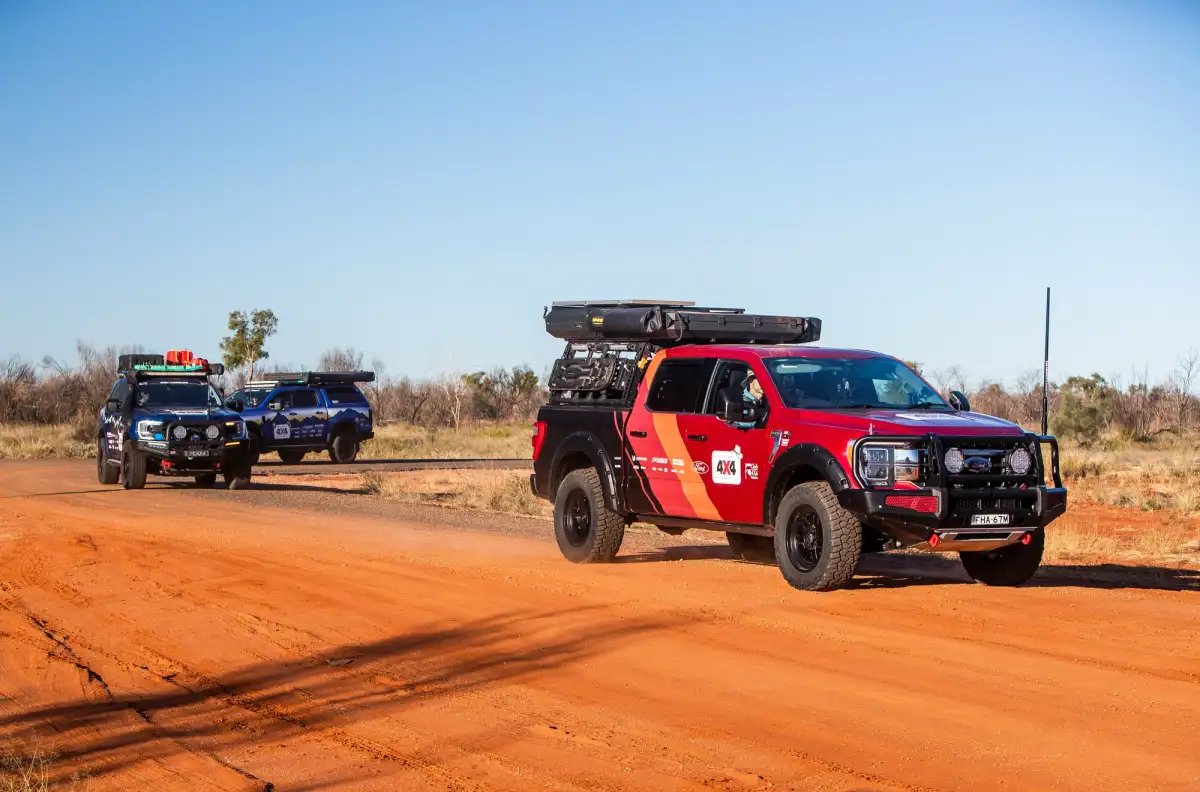
4X4 convoy travel in the Outback
Even in 2026, a walkie talkie, or as adults call it, an ultra high frequency (UHF) radio,remains essential kit for any 4WD.. Mobile coverage is lending you no favours when you’re in the sticks. Whether you’re travelling in a convoy, overtaking a road train or towing a caravan, a quality UHF radio is there to keep yourself and other road users safe.
Why Every 4WD Needs a Good UHF Radio
Travelling remote might be about escaping your phone, but you probably depend on it more than you think.
For communication, navigation and staying organised, it’s part of everyday life. But once you’re outside cellular range, you need an alternative.
That’s where a UHF radio comes in. It doesn’t rely on mobile service and can do what phones were originally built for: communication, especially in an emergency. Unlike a phone, though, UHF radios operate on channels, each with a specific purpose.
Key UHF Channels to Know:
Channel 18 – The go-to channel for caravan and camper trailer owners. Handy if someone needs to alert you that something’s come loose.
Channel 10 – Commonly used by 4WD clubs and convoys.
Channel 40 – The main channel for truckies and an important road safety resource.
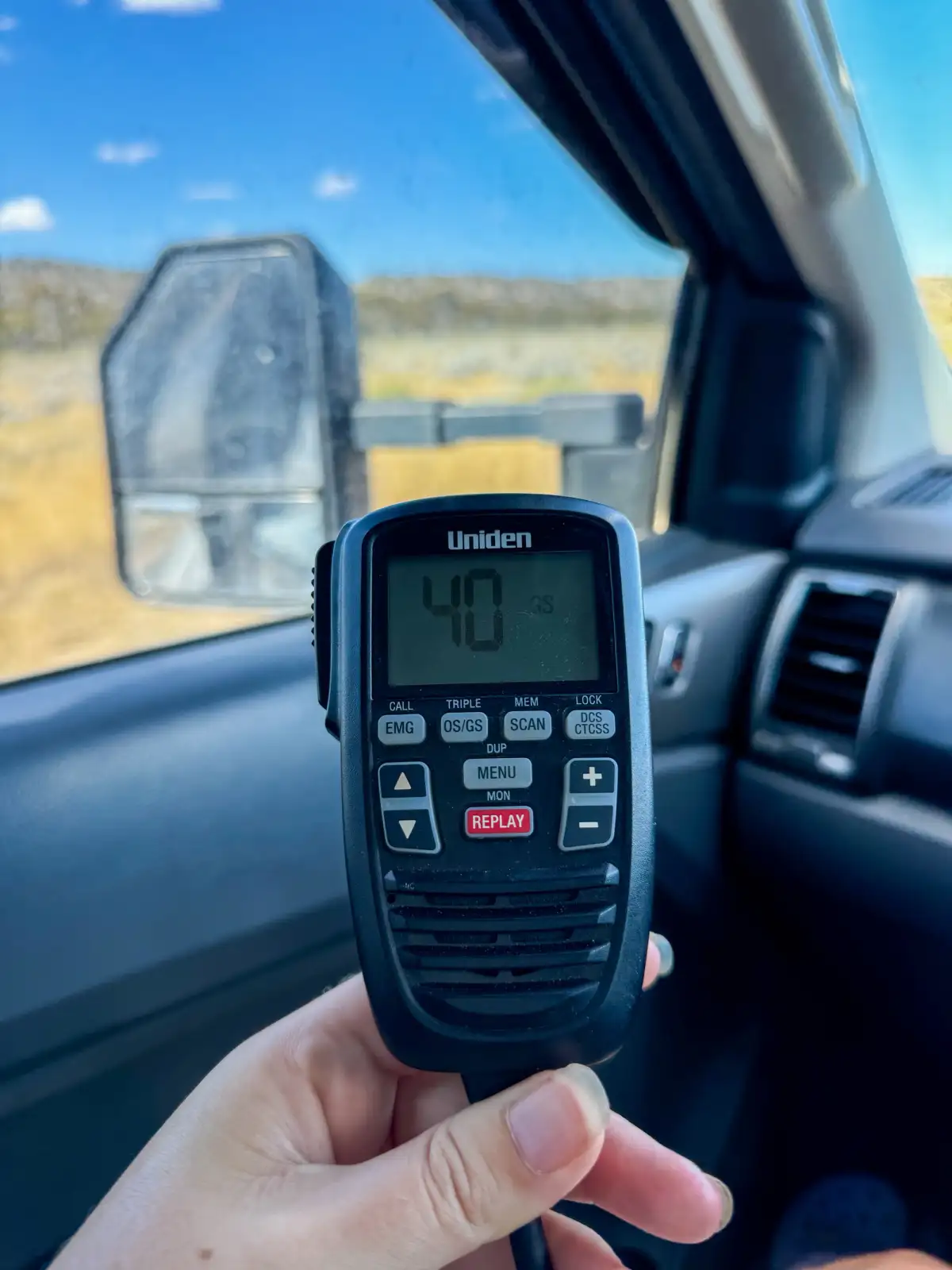
UHF CB radio in hand
Channels 5 and 35 – Emergency use only. These should only be used in a genuine emergency.
Channel 29 – Road safety channel for the Pacific Highway and Pacific Motorway.
Channel 11 – The call channel, used to make contact before moving to another channel.
General use channels – Suitable for convoy chat and day-to-day communication, including 9, 12–17, 19–21, 24–30, 39, plus extended channels 50–60, 64–70 and 79–80.
Channels 22 and 23 are reserved for data, while 61–63 are not for voice use.
There’s no licence required to use UHF in Australia, making it a simple tool to add to your touring setup.
UHF radios are especially useful in convoys, helping you coordinate fuel stops, warn of hazards, flag wrong turns, or keep everyone together on narrow or remote roads. In short, good communication makes travel safer, smoother and far less stressful.
What to Look for in a 4WD UHF Radio
Wattage & Range
The UHF radio you choose will depend on the type of touring or off-roading you’re undertaking. Options on the market range from 1W, ultra-compact and lightweight units perfect for keeping track of the kids around camp, to 5W waterproof, dustproof and Outback-proof designs that come packed with extra features for the true Aussie adventurer.
A 5W UHF handheld radio will typically provide a range of 3km to 5km in built-up or vegetated areas, but in open, clear or elevated terrain, they can reach up to around 15km. Opting for a more powerful radio can prove to be the difference in a sticky situation and is worth the investment.
Channel Scanning & Priority
Most newer UHF units have a group scan function, which allows you to select a number of channels to include in a group. Joining this group then allows you to listen to all selected channels at once, instead of having to scan all 80 channels.
Some radios will even scan in the background while you’re on your priority channel, so you can include emergency and truckie channels in your group and listen out for any comms there, but if a signal appears on your priority channel, it will override any other signals.
Durability & Build
Much like deciding on a wattage when shopping for a UHF, the build and durability of the radio should also be considered. Depending on your lifestyle, you may want a radio that is water and dustproof as well as able to cop an impact, caused either by the terrain or user clumsiness.
You’ll want to look for a radio’s ingress protection (IP) ratings. High quality, durable builds will often come with an IP67 rating, meaning they are dust-tight and can withstand immersion in water up to 1 metre for 30 minutes, perfect for off-road touring where corrugations and watercrossings can change even your 4WD cabin’s environment.
Mounting, Antennas & Installation

UHF CB radio antenna mounted on the bullbar of a 4X4 Ford Ranger
When choosing an antenna it’s important to base your decision on performance, not aesthetics. Antenna gain is measured in dBi (decibel relative to isotrope), which essentially means how good it is at concentrating radio frequency energy in a particular pattern or direction. Different dBis will suit different drivers and it mainly comes down to the terrain you will most often be tackling.
High Gain (8.1dBi) - Radiating in a straight, narrow path, this high gain signal is ideal for flat countryside where there are few obstacles hindering its signal.
Medium Gain (5.1-6.6dBi) - Best for mixed terrain where obstacles like hills and trees are present.
Low / Unity Gain (2.1dBi) - Working on a broad pattern, this signal outputs at the same level as its input, making it suitable for rugged, mountainous terrain.
If you’ve worked out which antenna will work for you, it’s time to mount it. Now, the obvious place for an antenna to get the best reception is on the centre of the roof, where the car isn’t obstructing it and it is at the highest point. This, however, isn’t very practical, what with roof racks, clearance heights to meet and general mounting issues.
Most people will mount their antenna on their bullbar, but this also has issues. Signals being transmitted behind the vehicle will be slightly impacted due to having to travel through the vehicle itself. Looking forward, any vehicles in front of you can also impact its signal.
Ideally, you want to install it somewhere it can clear the height of your roof. Whether that’s your bullbar, roof rack, bonnet or rear bar, just make sure you use a quality, hinged mount.
Portable vs Vehicle Mounted
For vehicle-to-vehicle communications, you’re going to be looking at either handheld or vehicle mounted UHFs (or both). A 5W handheld is a great option as it can be used just as a vehicle mounted one can, but also by a passenger for spotting when reversing a trailer or caravan. Even for other uses, these handhelds often outperform a vehicle mounted UHF if it hasn’t been installed properly or the coax cable from the antenna has been damaged.
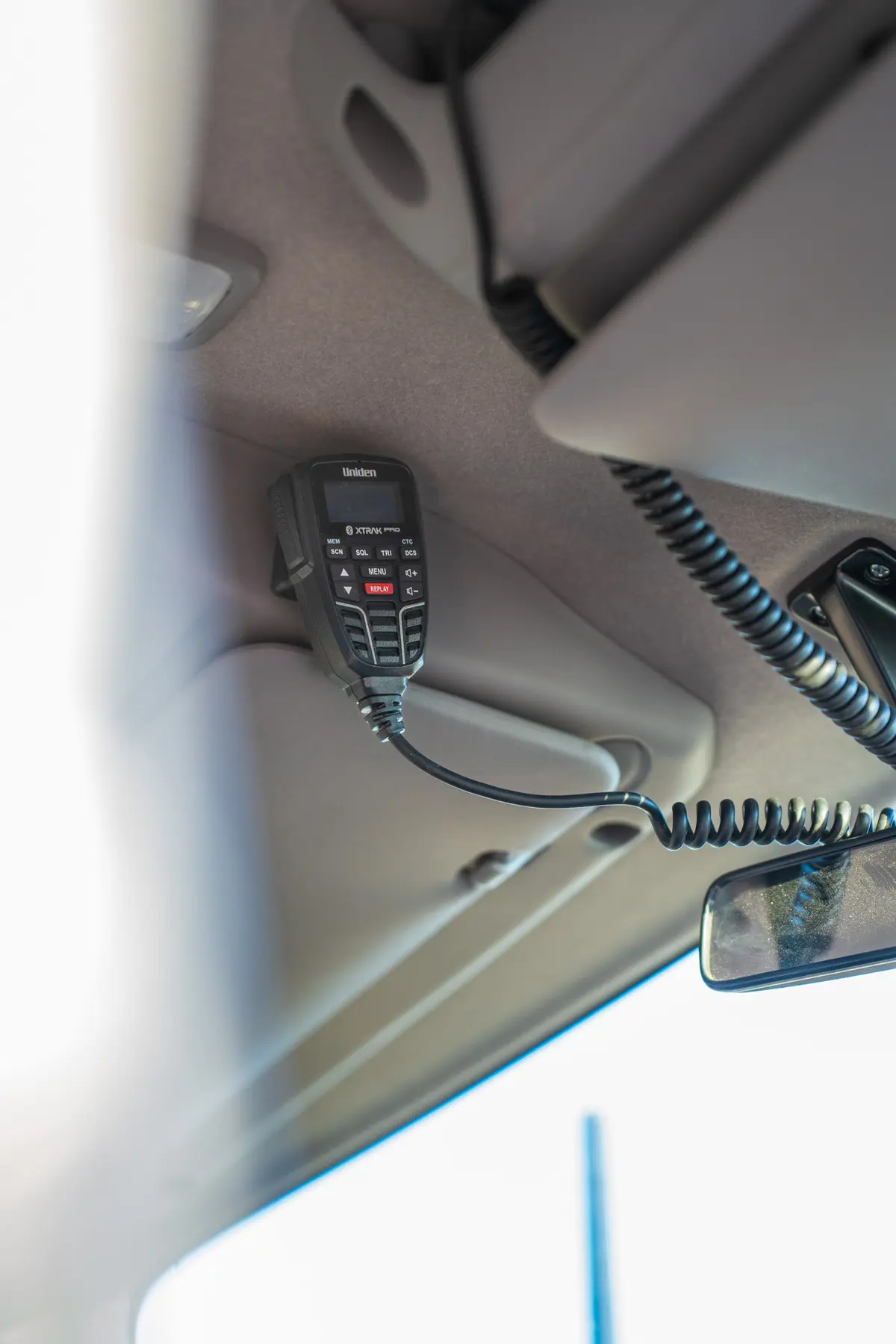
A UHF radio mounted inside a 4WD cabin
A vehicle mounted UHF radio is the ideal solution for a 4WD tourer. They provide better signal quality, don’t rely on batteries and are impossible to lose. They’re also usually wired to an ignition feed, so these radios switch on and off with the car. The antennas are typically mounted on the bullbar, with most modern bullbars coming with a specific antenna mount, but there are brackets available for those that don’t.
Ultimately, it can be a good idea to have both. The vehicle mounted unit for the tracks and as the main communication station and some handheld units for spotting and when you leave the 4WD behind on a bushwalk.
What is the Best UHF Radio for YOUR 4WD?
GME XRS‑330CTP Radio Touring Pack
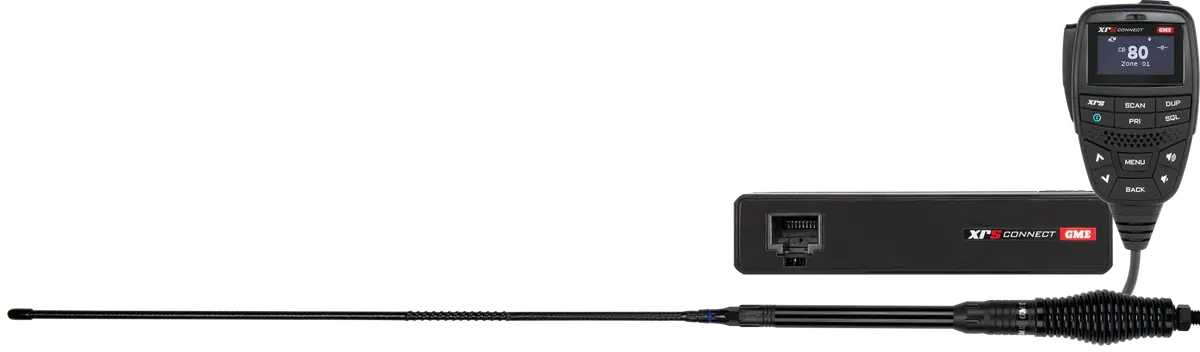
XRS330CTP UHF radio
Overview
Modern 4WDs often have complex dashboards that don’t always allow for a unit to be easily mounted. Thankfully, the GME XRS-330CTP UHF radio is able to be tucked away, out of sight. This way, the handpiece is the only part of the set that comes into the cabin and therefore houses all the controls, keeping it simple for drivers.
The touring pack comes with the radio and handpiece, elevated-feed antenna and bracket, microphone extension lead and adaptor kit and everything you’ll need for the cabin mount.
Key Features
- Made in Australia
- Bluetooth wireless technology
- All-in-one communication setup
- 2 watt front-facing speaker
- Super compact design
- User customisable buttons
- OLED speaker microphone
- Able to create and share scan lists
- XRS Connect app - bluetooth wireless technology
- Includes 6.6dBi elevated-feed antenna
Benefits
- Strong mix of performance and install flexibility
- Ideal for tight cabins and clean dash setups
- Reliable, clear communication in all conditions
Best For
Touring and dual-vehicle setups where ergonomic control is key.
GME XRS‑330C Connect Super Compact UHF CB Radio
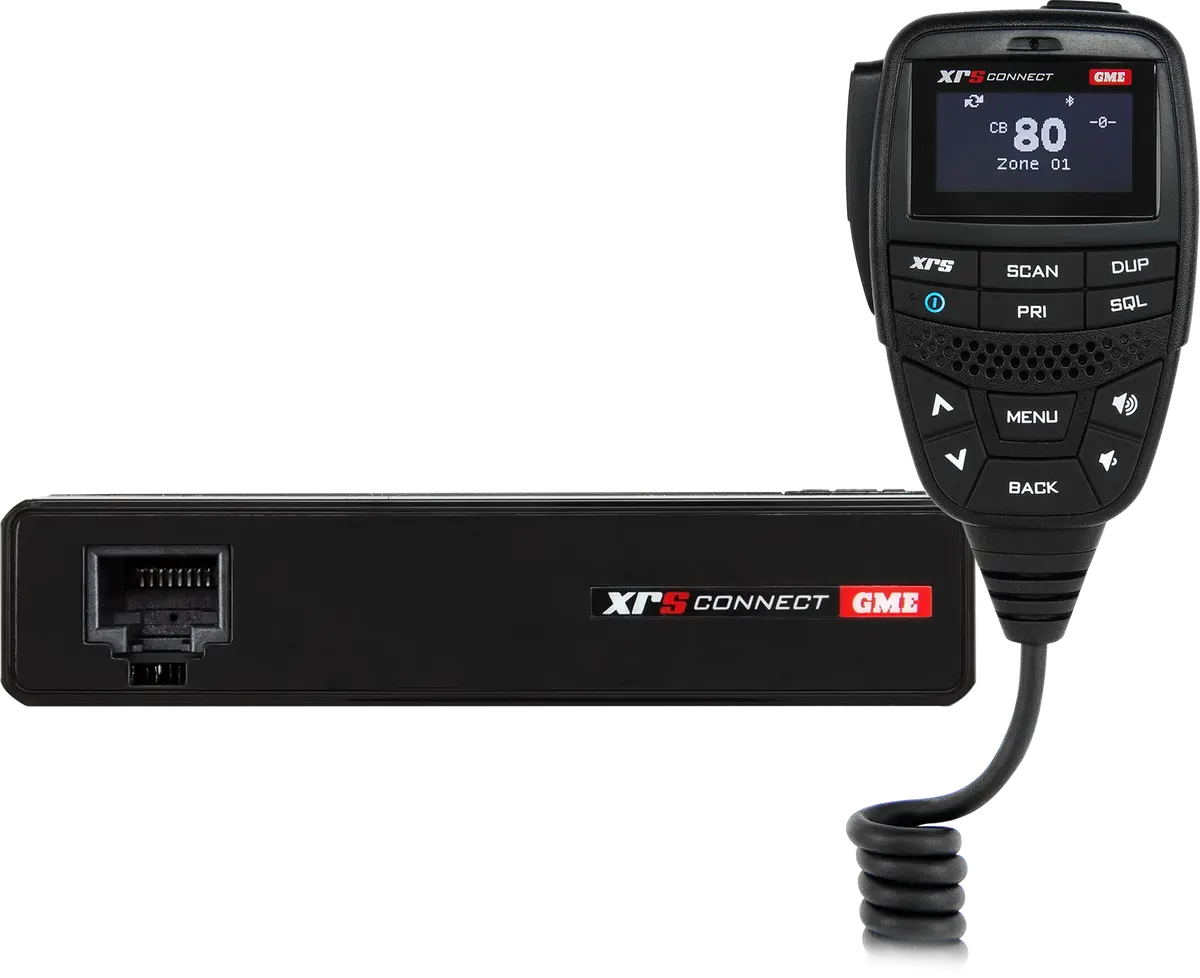
XRS330C UHF Radio
Overview
For those chasing a feature-packed setup, the GME XRS-330C stands out. Australian-made and built for modern 4WDers, it delivers excellent performance even if you never touch the advanced features. A bright OLED display, loud and clear handset speaker, and a highly flexible remote-mount control unit make it as practical as it is capable and one of the best Australian UHFs in 2026.
Key Features
- Made in Australia
- Compact control box with flexible mounting options
- Bright OLED screen with clear visibility
- Bluetooth connectivity via GME app for full control
- GPS-enabled frequency finder (within 50km)
- Programmable scanner with 20,000+ frequencies + 400 custom channels
- Magnetic microphone clip for quick access
- User customisable buttons
- XRS Location Services app for GPS tracking between vehicles
- 5W output (standard for Australian UHF)
Benefits
- Great mid-range option with long-lasting reliability.
- Ideal for frequent travellers who want dependable performance without premium cost.
Best For
4WD owners seeking a reliable, everyday UHF with good all-around features.
GME TX3100VP Super Compact UHF CB Radio Starter Kit
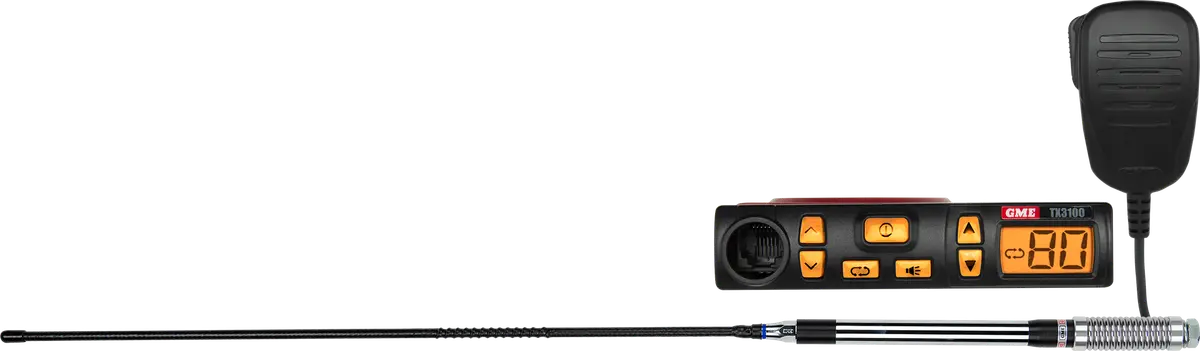
TX3100VP UHF radio
Overview The GME super compact UHF CB is a straightforward, entry-level option for adding reliable comms to your setup. Supplied as a complete starter kit, it includes everything needed for install, while the ultra-compact chassis and flip display make it easy to mount discreetly in modern vehicles.
Key Features
- 5W output with simple operation
- Digital signal processing for clearer audio
- Dynamic volume control
- Super compact design for tight installs
- Unique flip display for flexible mounting
- External speaker socket
- Complete kit with radio, mic, antenna, and mounting hardware
Benefits
- Excellent value with all essentials included
- Quick, hassle-free installation
- Clean, low-profile fit in modern cabins
- Clear and reliable communication without complexity
Best For New 4WD owners or casual tourers wanting dependable comms without the extra tech.
Uniden 5 Watt UHF CB Splashproof Handheld Radio UH755
Overview
The UH755 handheld UHF is a tough, no-fuss unit built for real-world use. With a splashproof design, solid battery life, and a clear backlit display, it’s made to handle everything from camp duties to trackside spotting. With up to 17km range (line of sight), it punches well above its size for portable comms.
Key Features
- 80 UHF channels
- Durable metal alloy chassis
- Up to 35 hours operating time
- Backlit LCD dot matrix display
- Splashproof for outdoor use
- 5W output for maximum handheld range
- Includes antenna, rechargeable battery, charge cradle, belt clip, and wrist strap
Benefits
- Reliable backup if your main in-vehicle unit goes down
- Strong range for a handheld, ideal for off-vehicle communication
- Built tough for outdoor conditions
- Long battery life reduces the need for constant recharging
Best For
Spotters, bushwalkers, and as a dependable secondary or emergency communication tool.
Oricom UHF360RAH UHF CB Radio and Antenna Pack
Overview
The Oricom UHF360RAH radio and antenna pack is built for off-road conditions, combining a rugged compact receiver with a controller speaker mic for easy in-cab use. Its standout replay function lets you capture and revisit missed transmissions, which is especially handy when things get noisy or technical on the tracks.
Key Features
- Large, easy-to-read LCD display
- Rugged micro-size receiver for flexible install
- Tri-colour backlit display
- Priority scanning
- Instant replay (up to 10 minutes of recording)
- 6.5dBi black antenna included
- LED torch built into the handset
Benefits
- Never miss important comms with replay functionality
- Simple, space-saving install for tighter cabins
- Solid range and signal performance with included antenna
- Easy to use in low light with backlit display and built-in torch
Best For
Off-roaders and touring setups where reliability, simplicity, and the ability to replay missed calls are essential.
The Safety Mindset
When touring Australia, a UHF can become your primary line of communication. No matter which unit you land on, the best UHF in Australia is the one inside your 4WD.
For some travellers, a UHF will allow for clear and constant communication between vehicles in convoys which helps to manage hazards, turns and recovery situations. For solo travellers, it means more track awareness and an emergency communication device.
So whether it’s a high-end unit with GPS and scanning or a simple handheld backup, having a UHF is less about convenience, but about genuine safety. In a country as vast and unpredictable as Australia, it might just prove essential.
Bush bound?
Get comprehensive insurance that can go there too.